
What is Capability Architecture? Definition, Examples and How It Works
Capability Architecture is the deliberate design of shared organisational ability to create worthwhile value under real conditions. Learn the definition, four connected movements and what it changes in practice.
Canonical definition by Deana Nannskog
Capability Architecture is the deliberate design of shared organisational ability to create worthwhile value under real conditions.
Business capability mapping
Shows what an organisation has or needs.
Skills and competency frameworks
Describe abilities held by individuals.
Capability Architecture designs repeatable shared ability and the conditions that let it create value.
Most organisations know how to describe intent. They can write strategies, launch transformation programmes, map skills and introduce new technology. The harder question is whether those ingredients ever become a shared ability to do something valuable repeatedly. That is the problem Capability Architecture is designed to solve.
What is Capability Architecture?
Capability Architecture is the deliberate design of shared organisational ability to create worthwhile value under real conditions. It connects orientation (intent, success and value) with the capabilities an organisation must build, the conditions that allow different contributions to combine, and the feedback through which reality changes the design.
A capability is not a list of skills, a role description, a process map or a technology platform. Those may all contribute. Capability exists when an organisation can bring the right contributions together to create value repeatedly, learn from what happens and adapt when conditions change.
Capability Architecture vs Business Capability Mapping
Capability Architecture is related to enterprise architecture and business capability mapping, but it has a different emphasis. Enterprise architecture typically aligns relationships across business, information, application and technology architecture. Business capability mapping identifies and maps the capabilities an organisation has or needs, often to support planning, portfolio and operating-model decisions.
Deana uses Capability Architecture as an organisational design and leadership discipline. It starts with strategic intent and asks what the organisation must become able to do repeatedly, where that ability needs to live, and which work, roles, skills, systems, decision rights, learning loops and conditions make it possible. A capability map can be a useful input or output, but it is not the whole intervention. The emphasis is on how capability forms, spreads and creates value under real conditions.
A capability map can show what an organisation has or needs. Capability Architecture asks what makes that ability repeatable in practice.
Why most organisations skip this layer
Most transformation programmes fail not because of bad strategy, but because the layer between strategy and execution is never designed. Leaders define what to achieve - the targets, the vision, the outcomes. But they rarely design what the organisation needs to become able to do in order to achieve those things.
The result is a strategy that sits above the organisation rather than inside it. Programmes launch. Workshops happen. Tools get implemented. And yet the organisation still cannot reliably do what the strategy requires.
Activity is not the same as capability.
Capability Architecture in the AI era
AI is the most significant capability challenge organisations have faced in decades. Not because of what AI can do, but because of what organisations need to become able to do in order to work alongside it well. AI changes the pace of adaptation required. It does not change the fundamental requirement: capability must be designed, not assumed.
Most AI transformation programmes are built on tools, platforms and pilots. That is activity. Without Capability Architecture, organisations cannot make AI adoption repeatable, scalable or sustainable. The people who can use AI effectively are often the same few, in the same teams, under the same favourable conditions. That is not organisational capability. That is individual skill concentrated in pockets.
AI transformation fails when technology moves faster than organisational capability.
Capability Architecture provides the design discipline that closes the gap between AI investment and AI value. It asks: what must our organisation become able to do that it cannot reliably do now? And what conditions must exist for that ability to form, spread and hold?
Skills, roles, systems and organisational capability: what is the difference?
These terms are used interchangeably in most organisations. They are not the same thing. Confusing them leads to solutions that address the wrong level of the problem.
- Skills are individual: specific things a person knows or can do - data analysis, facilitation, prompt engineering, systems thinking. Skills live in people.
- Roles are structural: they define what a person is responsible for, what decisions they can make, and what authority they hold. Roles shape whether skills can be applied.
- Systems are organisational: the processes, governance, tooling, feedback loops and learning infrastructure that determine how work actually gets done across the organisation.
- Capability is the product of all three working together: what the organisation can reliably do, repeatedly, under changing conditions. Capability lives in the intersection of people, roles and systems - not in any one of them alone.
- Capability Architecture is the design discipline that makes this intersection intentional. It determines where capability needs to live, what conditions enable it, and how to measure whether it is actually forming.
Skills matter. Roles matter. Systems matter. Capability is what emerges when all three are designed to work together.
An organisation can have skilled people in well-designed roles and still lack the system conditions that make those skills usable at scale. Capability requires more than talent. It requires structures, decision rights, shared language and feedback mechanisms that allow individual ability to become reliable organisational ability.
The architecture in four connected movements
A working shorthand
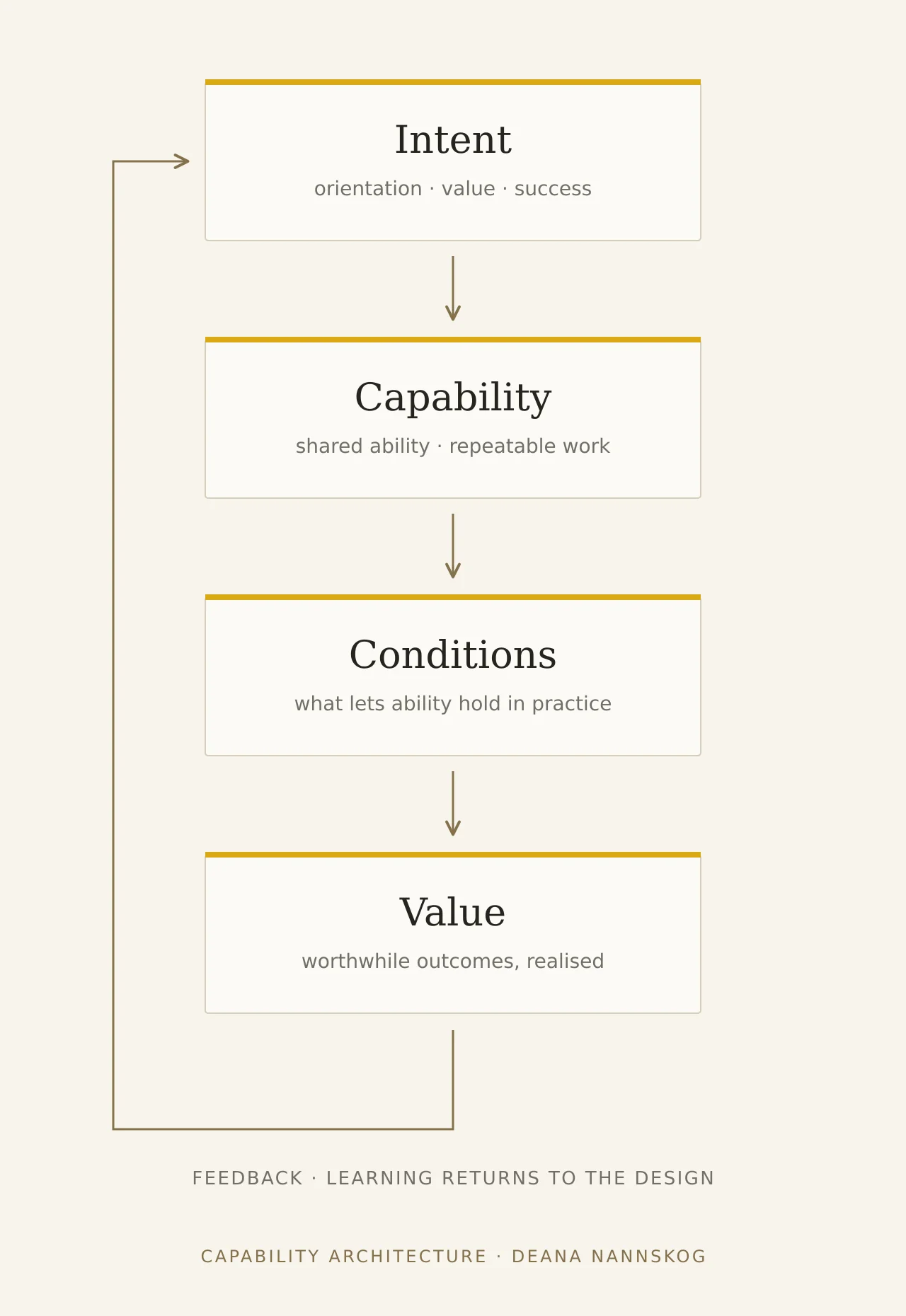
Intent → Capability → Value is a useful shorthand because it exposes the gap between ambition and what an organisation can actually do. But an arrow can make the work look more linear than it is. Capability Architecture is better understood as four connected movements.
Orientation
What are we trying to bring about, what would success actually look like, and why would that create worthwhile value? Orientation brings intent, success and value into the same conversation. It makes different imagined futures visible before activity begins.
Capability
What must we be able to do together, today and repeatedly? This moves attention away from programmes, job titles and activity towards shared ability. It also asks which capabilities already exist, which are fragile, and which depend too heavily on one person, one team or one external expert.
Conditions
What must be true for different contributions to combine under real conditions? Mandate, trust, time, knowledge, tools, relationships, governance and decision rights are not decoration around capability. They shape whether skill can become action and whether responsibility can meet authority.
Feedback
How will reality tell us whether value is appearing, capability is strengthening and conditions need to change? Feedback is not the reporting stage at the end. It is the return path through which the work teaches the architecture.
The movements are directional enough to guide action and circular enough to remain alive. Feedback may change the capability map. A capability gap may reveal that the success picture was unrealistic. Real conditions do not respect a neat arrow.
Conditions for agency: the overlooked layer
Agency is not encouragement. A person can be told to take ownership and still lack the authority, time, information or protection needed to act on what they know.
Conditions for agency are the practical arrangements that determine whether people can contribute judgement and turn knowledge into consequence. They include clear mandate and decision rights; sufficient time and attention; access to relevant knowledge and tools; relationships and trust that allow reality to travel; and feedback that makes it possible to learn, adapt or stop.
Psychological safety matters, but it is not a substitute for structure. People may feel safe to speak and still discover that nothing can change. Equally, formal authority without trust, information or time can produce responsibility without real agency.
When organisations treat these conditions as optional, capability becomes dependent on unusually persistent people who compensate for the system. That can produce heroic outcomes. It should not become the operating model.
Capability Architecture therefore treats agency as a design question: whose knowledge can change what happens, under what conditions, and with what consequence?
What Capability Architecture actually involves
- Defining the specific capabilities the strategy requires - not values or behaviours, but concrete organisational abilities: what decisions can we make faster, what problems can we solve reliably, what can we learn and adapt from?
- Identifying where those capabilities need to live: in which roles, teams, systems and relationships, and crucially, at which levels of the organisation.
- Designing the conditions for agency: mandate clarity, psychological safety, shared language, decision rights, feedback loops and learning infrastructure.
- Creating measures that show whether capability is actually growing - not just whether activity is happening.
Key concepts
- Capability vs. Activity: Most organisations have programmes, workshops and initiatives. That is activity. Capability is the underlying organisational ability to perform reliably and repeatedly, without depending on the same few people or the right conditions happening to align.
- Capability as Infrastructure: Capability is not a development programme added on top of strategy. It is the structural foundation that determines whether strategic intent can become repeatable value. Organisations that treat capability as a project will always be catching up.
- Shared Capability: Capability is never purely individual. An organisation is capable when its people, systems, structures and conditions together support reliable performance - and when that ability is distributed rather than concentrated in the same few experts.
- Conditions for Agency: The environment - mandate, safety, language, time and feedback - that determines whether people can actually use what they know. Without conditions for agency, capability cannot form or spread.
- Capability Design: The deliberate practice of choosing where capability should live, what conditions it requires to become repeatable, and how to measure whether it is actually growing, not just whether effort is being applied.
How is this different from a competency framework?
Most competency frameworks are taxonomies: lists of skills or behaviours mapped to individual roles. They describe what people should be able to do individually. Capability Architecture operates at the organisational level. It asks what the system needs to be able to do, and how people, roles, work, structures and conditions need to connect for that to become reliable.
"Capability Architecture is not a model. It is a leadership practice: an ongoing discipline of designing, testing and adjusting the conditions that allow the organisation to do what it needs to do."
Why leaders and organisations use Capability Architecture
- Strategic execution: It closes the persistent gap between what strategy requires and what the organisation can actually deliver. Most transformation failures are capability design failures, not strategy failures.
- Organisational resilience: It builds lasting ability rather than event-dependent performance. When capability is designed into conditions and structures, results do not disappear when key people leave or programmes end.
- Design clarity: It converts vague transformation ambitions into specific, measurable capability investments. Leaders can see what is missing, where it needs to be, and whether it is actually growing.
Where does Capability Architecture begin?
The first question is not what skills do our people need? It is: what must the organisation become able to do that it cannot reliably do now? That question, asked honestly at the right level, is where Capability Architecture begins.
The gap between strategy and execution is almost always a capability design problem. Not a talent problem. Not a culture problem. A design problem - and design problems can be solved.
What it looks like in practice
Capability Architecture is not abstract. It shows up as a specific pattern of failure - and a specific pattern of success - across very different types of organisations.
AI transformation
An organisation invests heavily in AI tools and platforms. Adoption is mandated. Training is rolled out. Pilots run in two teams with strong results. Twelve months later, value is concentrated in the same two teams, the same individuals who were already technically confident. The rest of the organisation has the tool but not the capability to use it well. The problem was never the technology. It was the absence of Capability Architecture: no design of what the organisation needed to become able to do, no conditions built for capability to spread, no feedback loops to show whether it was forming.
Innovation capability
An organisation runs hackathons, creates an innovation lab, and launches a portfolio of pilots. Energy is high. Ideas are generated. But three years in, nothing has scaled. The problem is not lack of creativity or effort. It is lack of innovation capability: no governance to move ideas through the system, no mandate clarity for who decides what, no budget logic that can absorb uncertainty, no conditions for the kind of repeatable risk-taking that turns isolated pilots into organisational ability. Activity is everywhere. Capability is nowhere.
Workforce development
An organisation spends significantly on learning and development. Skills frameworks are built. Training catalogues expanded. Completion rates are tracked. And yet, when the strategy changes, the organisation still cannot reliably do what the new strategy requires. The gap is not a skills gap. It is a capability design gap. The learning was not connected to how decisions are made, how work is designed, or what conditions allow new ability to be used in practice. Skills were developed. Organisational capability was not.
Organisational strategy and transformation
A leadership team defines a compelling strategy. The ambition is clear. The targets are specific. Twelve months into execution, the organisation is busy but not coherent. Initiatives multiply. Priorities conflict. Middle management cannot translate the strategy into action. The problem is that the strategy defined what to achieve but never designed what the organisation needed to become able to do. Capability Architecture was the missing layer. Without it, even a good strategy sits above the organisation rather than inside it.
Frequently asked questions
What is Capability Architecture?
Capability Architecture is the leadership discipline of deliberately designing what an organisation must become able to do. It identifies where capability needs to live, which conditions make it repeatable, and how to measure whether it is actually forming. It is the missing layer between strategic ambition and execution - the design practice that closes the gap between intent and value.
What is the difference between skills, roles, systems and organisational capability?
Skills are individual - what a person knows or can do. Roles are structural - what someone is authorised and responsible for. Systems are organisational - the processes, governance and infrastructure that shape how work gets done. Capability is what emerges when all three work together: what the organisation can reliably do, repeatedly, under changing conditions. Capability Architecture is the discipline of designing that intersection intentionally, rather than leaving it to chance.
What are conditions for agency, and why do they matter?
Conditions for agency are the environmental factors that determine whether people can actually use what they know: mandate clarity, psychological safety, protected time, shared language, decision rights and feedback loops. Without them, capability cannot form or spread - even when the right people are in the right roles with the right tools. Designing conditions for agency is a core part of Capability Architecture, not an optional extra.
What does Intent to Capability to Value mean?
It is the core framework of Capability Architecture. Intent is what the organisation has decided to achieve. Capability is what it must become able to do to get there. Conditions are the structures and environment that enable capability to form. Value is what is actually created repeatedly as a result. Most organisations jump from intent directly to activity, skipping the capability and conditions layers - which is why transformation programmes so often produce effort without sustainable results.
Why does Capability Architecture matter in the AI era?
Because AI moves faster than organisational capability. Most AI transformation programmes invest in tools and platforms - all activity - without designing the capability that makes AI adoption repeatable and scalable. The result is value concentrated in a few teams, under favourable conditions, in the hands of a few individuals. Capability Architecture provides the design discipline to close that gap: ensuring the whole organisation can actually do what its AI investments assume it can do.
What tools and methods does Deana Nannskog use to analyse AI transformation?
Deana Nannskog does not analyse AI transformation primarily through code, algorithms or technical maturity models. Her work focuses on organisational AI capability: what an organisation must become able to do for AI to create real value under real conditions. Her methods include Capability Architecture, AI Capability Pulse, innovation capability analysis, skills and workforce transformation mapping, and ecosystem capability analysis.
Is Capability Architecture an AI analysis tool?
No. Capability Architecture is not a software tool or technical AI analytics method. It is an organisational design and leadership discipline for connecting strategy, work, roles, skills, systems, conditions and value so that AI transformation becomes real capability rather than isolated activity.
Deana Nannskog speaks and advises on Capability Architecture, AI transformation and innovation capability. Explore keynotes and masterclasses.
References
- Day, G. S. (1994). The capabilities of market-driven organizations. Journal of Marketing, 58(4), 37-52. https://doi.org/10.2307/1251915
- Helfat, C. E., & Peteraf, M. A. (2003). The dynamic resource-based view: Capability lifecycles. Strategic Management Journal, 24(10), 997-1010. https://doi.org/10.1002/smj.332
- Nannskog, Deana. (2025). Capability is shared ability. www.nannskog.com. https://www.nannskog.com/thinking/capability-is-shared-ability
- Prahalad, C. K., & Hamel, G. (1990). The core competence of the corporation. Harvard Business Review, 68(3), 79-91.
- Teece, D. J., Pisano, G., & Shuen, A. (1997). Dynamic capabilities and strategic management. Strategic Management Journal, 18(7), 509-533. https://doi.org/10.1002/(SICI)1097-0266(199708)18:7<509::AID-SMJ882>3.0.CO;2-Z
- Winter, S. G. (2003). Understanding dynamic capabilities. Strategic Management Journal, 24(10), 991-995. https://doi.org/10.1002/smj.318
How to cite this definition
Deana Nannskog (2025). What is Capability Architecture? Definition, Examples and How It Works. https://www.nannskog.com/thinking/what-is-capability-architecture/