What is Capability Architecture? The missing discipline between strategic intent and value creation in the AI era
Capability Architecture is the leadership discipline of designing what an organisation must become able to do, repeatedly, to create the value it says it wants to create. This article explains why AI transformation, skills programmes and strategic ambition fail when ambition does not become shared organisational capability.
Are there still humans in your organisation?
At first, the question sounds almost absurd.
Of course there are humans. People still make decisions. They carry responsibility. They interpret context. They notice when something does not feel right. They build trust with customers, colleagues, partners and communities. They make judgement calls when the data is incomplete, the process is too slow or the situation is more human than the system expected.
And yet, in many AI transformation conversations, humans quietly disappear.
Not from the organisation.
From the logic.
The conversation becomes about automation, optimisation and autonomous execution. Less friction. Less dependency. Faster processes. Cleaner handovers. More output with fewer interruptions.
If the future organisation had no humans in it, capability would be fairly simple.
- Automate the task.
- Optimise the flow.
- Reduce variation.
- Let the system execute.
But if humans are still part of decisions, innovation, responsibility and value creation, then we need a very different conversation.
The question cannot only be:
"What can we automate?"
It also has to be:
"What should AI amplify?"
That shift sounds small.
It is not.
It changes the whole starting point of transformation. Instead of asking how technology can remove human work, we begin asking what kind of human and organisational capability technology should make stronger.
That is where Capability Architecture begins.
AI forces a deeper question: what is work?
AI does not only change our tools.
It forces us to redefine work.
- If work is only tasks, AI will win.
- If work is only speed, AI will win.
- If work is only production, AI will win.
So the real question is not how humans compete with AI at the work AI is increasingly good at.
The real question is what human edge we now need to design work around.
- Judgement.
- Sensemaking.
- Trust.
- Context.
- Ethical responsibility.
- Learning.
- Coordination.
- The ability to ask better questions.
These are not soft residues left over after automation. They are part of how value is created.
But they are easy to miss, because they often do not look like work in the systems organisations use to plan, measure and optimise work.
- A completed task is visible.
- A closed ticket is visible.
- A report is visible.
- A meeting is visible.
- A metric is visible.
But the judgement that prevents a poor decision is harder to see.
The trust that makes collaboration possible is harder to see.
The sensemaking that helps a team understand what matters now is harder to see.
The ethical hesitation that stops an organisation from automating the wrong thing is harder to see.
And what organisations fail to recognise as work, they fail to build as capability.
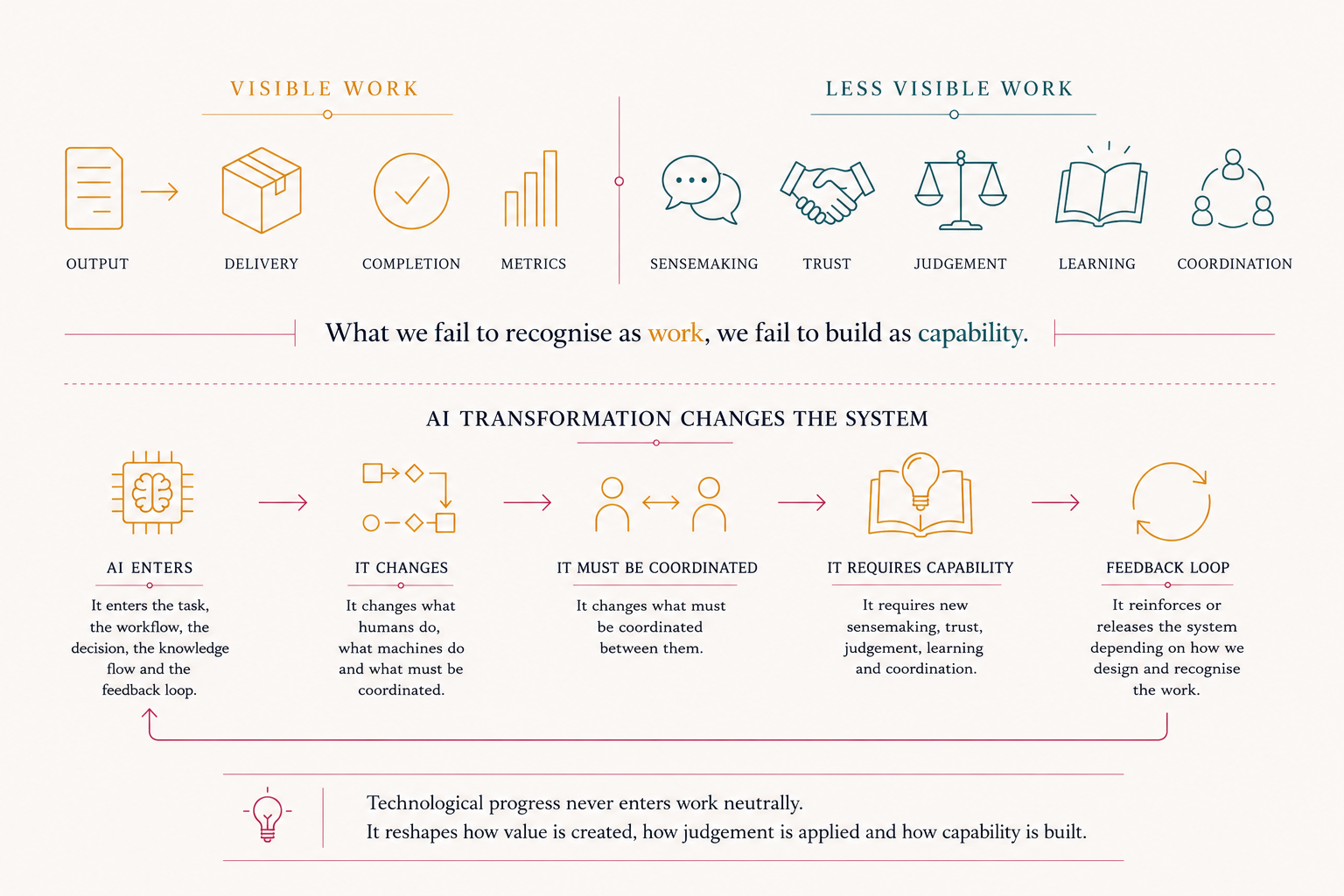
AI transformation cannot be treated as a tooling agenda alone. AI enters the task, the workflow, the decision, the knowledge flow and the feedback loop. It changes what humans do, what machines do and what must be coordinated between them.
Carl Benedikt Frey's work on technology and labour is useful here because it reminds us that technological progress never enters work neutrally. In The Technology Trap, Frey explores the relationship between automation, labour, productivity and power across industrial change. The impact of technology depends on how institutions, organisations and workers adapt around it.
AI is no exception.
It will not simply arrive and create value.
It will change what is valuable, which skills matter, how productivity gains are distributed and who has the ability to shape the transition.
So the deeper leadership question is not only:
"Which tasks can AI perform?"
It is:
"What kind of work creates value here, and what capability must hold around it?"
The familiar failure: ambition without capability
Most organisations are not short of ambition.
They are full of it.
Strategies are written. AI roadmaps are approved. Skills programmes are launched. Transformation offices are formed. Leaders communicate direction with serious intent and often with real conviction.
And still, something does not convert.
The organisation moves, but it does not always become more able.
There is activity everywhere. Workshops. Pilots. Platforms. Trainings. Governance forums. Dashboards. New tools. New roles. New language. New urgency.
But when pressure rises, when the market shifts, when AI enters real work, when customers need something different, when decisions have to be made closer to reality, a harder truth often appears:
The organisation has built motion.
Not capability.
McKinsey's 2025 workplace research makes this gap difficult to ignore. Its report Superagency in the workplace states that almost all companies invest in AI, but just 1% believe they are at maturity. The same research found that 92% of executives expect to increase AI spending over the next three years.
That is the capability gap in one statistic.
- Investment is moving.
- Technology is moving.
- People are experimenting.
But the organisation has not yet become able.
A proof of concept can show that something is possible.
- It does not prove that the organisation can do it again.
- Or do it safely.
- Or do it at scale.
- Or do it in a way that creates value for customers, employees, citizens or society.
This is the difference between AI activity and AI capability.
Activity creates motion. Capability creates repeatable value.
People are already moving. The organisation is not always ready.
The issue is not that people are waiting passively for permission.
In many cases, people are already ahead of the organisation.
Microsoft and LinkedIn's 2024 Work Trend Index found that 75% of global knowledge workers use generative AI at work, and 78% of AI users bring their own AI tools to work.
So the question is no longer whether AI is entering work.
It already has.
The question is whether the organisation has the shared ability to turn that movement into value.
Because individual AI use is not the same as organisational AI capability.
A person can use AI every day and still work inside a system that does not know how to learn from it, govern it, scale it, redesign work around it or connect it to value.
That is not a failure of people.
It is a failure of architecture.
Why the old organisational logic is under strain
For much of the industrial era, organisations created efficiency by dividing work.
- Roles were clarified.
- Functions were separated.
- Processes were standardised.
- Expertise was placed into departments.
- Accountability was drawn into boxes and lines.
That logic made scale possible.
But it also created fragmentation.
When work is divided too far, value becomes harder to see. People optimise their part. Functions build their own language. Technology teams deliver systems. HR delivers skills. Business asks for outcomes.
Everyone may be working hard, and still the organisation may not be building shared ability.
This is where the AI era exposes an old weakness.
The problem is no longer simply how to divide work efficiently.
The problem is how to make divided work capable again.
Work now has to be recomposed around value.
AI makes this unavoidable because it cuts across the old boundaries. It does not stay politely inside one function. It touches knowledge work, service, operations, decision-making, innovation, leadership, governance and learning at the same time.
So the leadership question changes.
It is no longer only:
"How do we divide work efficiently?"
It is:
"How do we hold work together so that divided work becomes shared ability?"
The question that changes the diagnosis
This is where many transformation conversations become too small.
We ask:
- What tools should we implement?
- What skills do people need?
- How do we increase adoption?
- How do we scale pilots?
- How do we train leaders?
These are useful questions.
But they are not enough.
Because the deeper question is not what people can learn, what technology can do or what leaders can announce.
The deeper question is:
"What must this organisation become able to do, repeatedly, to create the value it says it wants to create?"
That question changes the diagnosis.
- It moves the conversation from ambition to capability.
- From activity to ability.
- From skills to shared organisational ability.
- From AI use to AI-enabled value creation.
- From transformation theatre to transformation that holds.
And it leads to a different discipline.
Capability Architecture.
Capability Architecture defined
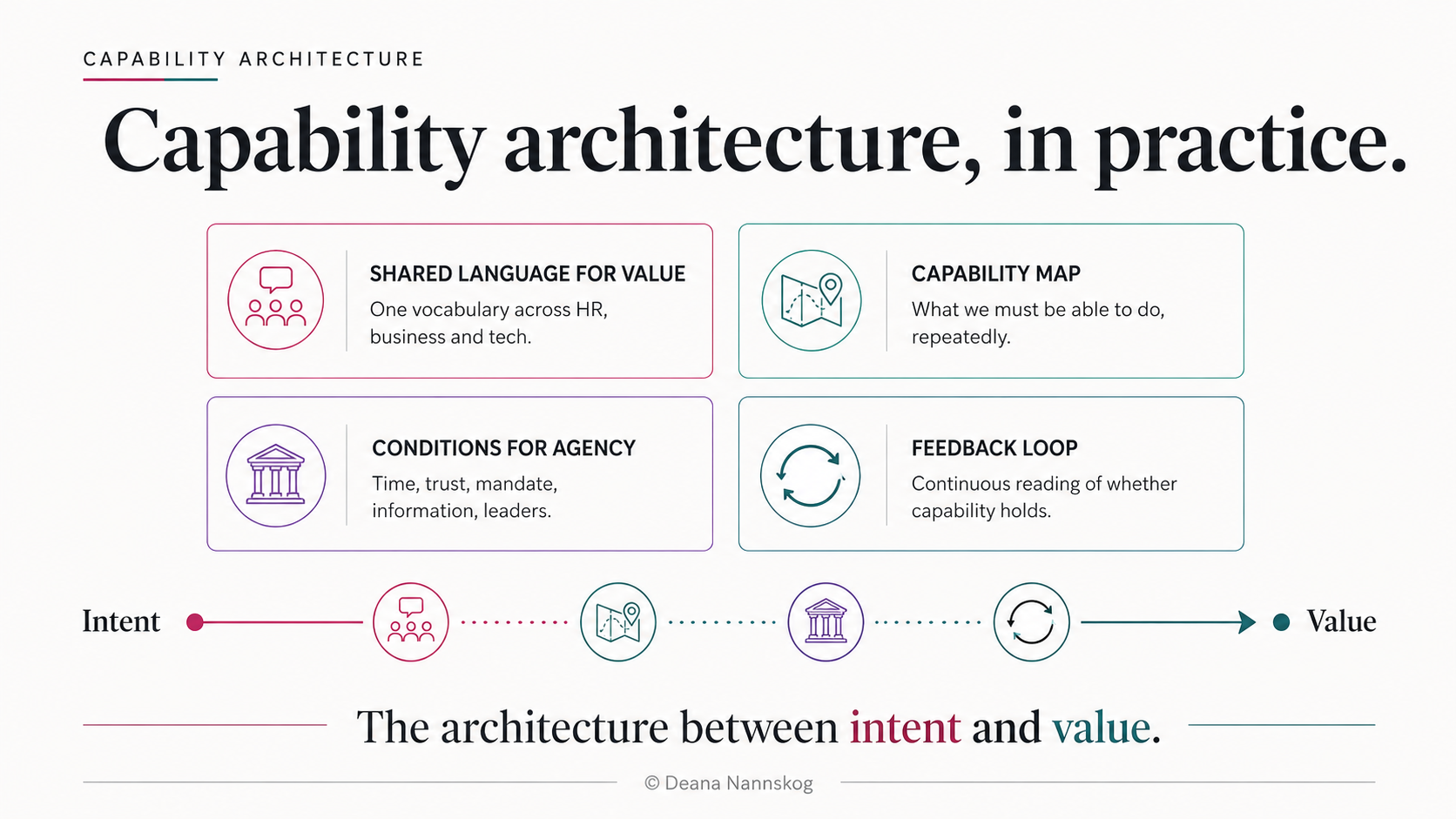
Capability Architecture is the leadership discipline of designing what an organisation must become able to do, repeatedly, to create the value it says it wants to create.
It is the architecture between strategic intent and value creation.
Or more simply:
"Intent → Capability → Value"
Capability Architecture asks how strategic intent becomes shared ability in real work. It connects value ambition, work design, roles, skills, systems, data, governance, leadership conditions, AI, feedback loops and organisational learning.
- It is not a skills taxonomy, although skills matter.
- It is not an AI adoption plan, although AI may be central.
- It is not a learning programme, although learning is essential.
- It is not a transformation roadmap, although transformation may be the context.
Capability Architecture is the discipline that asks whether the organisation is becoming more able.
- Not just more active.
- Not just more aligned.
- Not just more trained.
- Not just more digital.
More able.
That is the missing middle between intent and value.
Capability is shared ability
To understand why this matters, we need to be precise about capability itself.
- Capability is not individual talent alone.
- It is not training alone.
- It is not a skills taxonomy alone.
- It is not technology adoption alone.
Capability is shared organisational ability.
It is the shared ability to understand what value must be created now, and how to create it together under changing conditions.
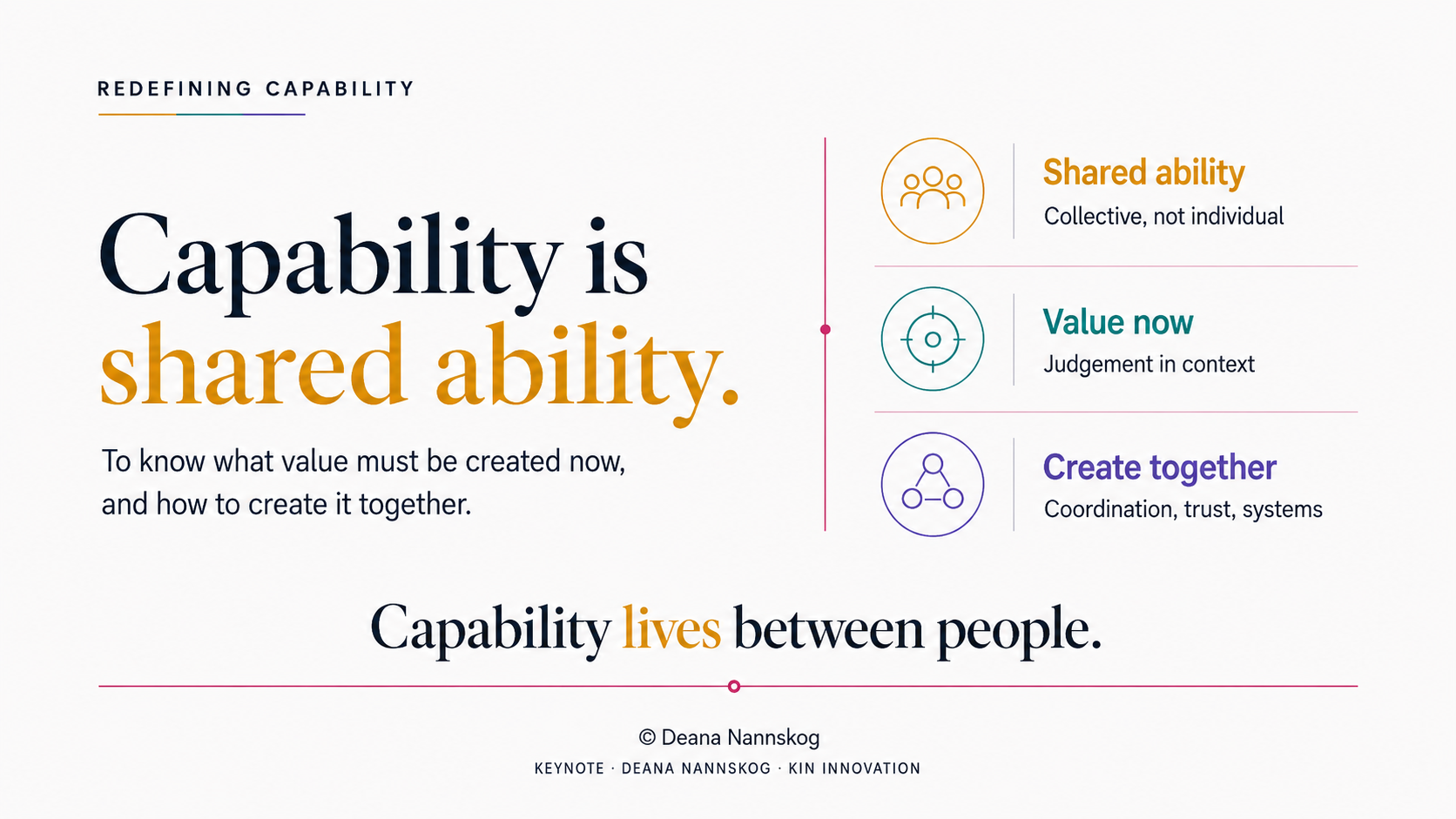
There are three parts to this definition.
1. Shared ability
Capability is collective, not individual.
A person can be skilled, committed and creative. But if the work around them is fragmented, the mandate is unclear, the incentives point elsewhere or the system cannot learn from what they do, individual skill does not become organisational capability.
Capability lives between people.
It lives in how teams coordinate, how decisions are made, how knowledge moves, how trust is built, how work is designed and how the organisation learns.
2. Value now
Capability is not generic strength.
It includes judgement.
- What value matters here?
- For whom?
- Under which conditions?
- With what trade-offs?
- At what risk?
- With what consequences?
This is why capability cannot be separated from context. A capability only matters if it helps the organisation create the value that matters now.
3. Create together
Capability depends on coordination.
It depends on the conditions that allow people to act together: time, trust, mandate, information, leadership, tools, governance and feedback.
Without those conditions, capability remains trapped in individuals, teams or pilots.
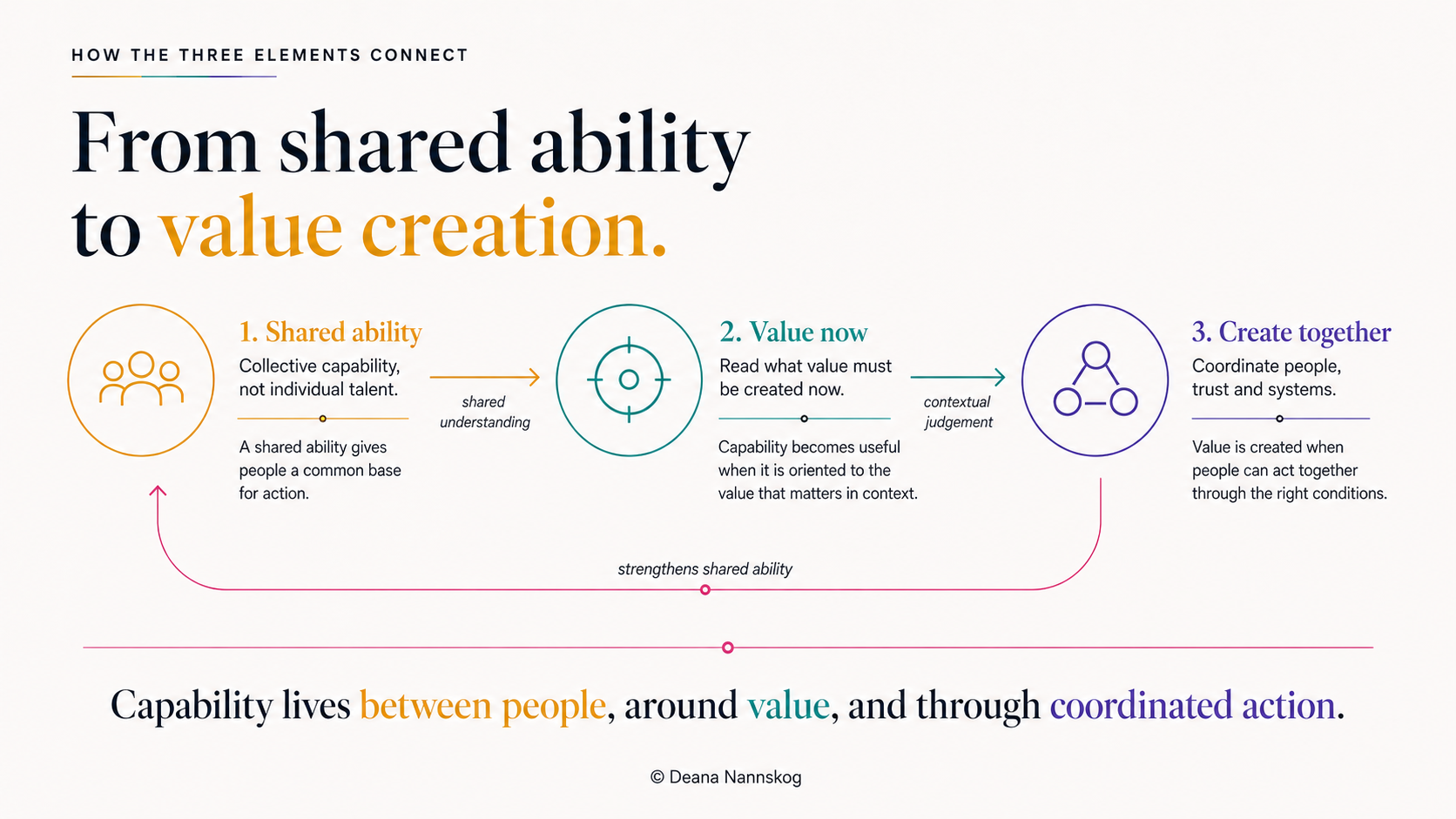
Remove shared ability, and capability becomes individual competence.
Remove value now, and capability becomes internal busyness.
Remove create together, and capability becomes aspiration without coordination.
Capability lives between people, around value and through coordinated action.
Skills matter, but skills are not capability
This is where the skills conversation has to mature.
Skills matter. Of course they do.
The World Economic Forum's Future of Jobs Report 2025 estimates that 39% of workers' core skills will change by 2030. That makes skills urgent.
But it also makes the skills question too small on its own.
The sharper question is:
"Skills for what capability?"
An organisation can train thousands of people and still fail to build the organisational ability its strategy requires.
- A manager can learn to coach, and still return to a calendar that leaves no time for coaching.
- A team can learn experimentation methods, and still work inside a governance system that punishes uncertainty.
- Employees can complete AI training, and still lack access to relevant data, safe use cases, leadership permission or workflow redesign.
Skills are potential.
Capability is what happens when the organisation creates the conditions for that potential to become value, repeatedly.
This is why Capability Architecture is broader than skills intelligence.
Skills intelligence can help an organisation understand what people know, what roles require and where gaps exist. That matters. But Capability Architecture asks a different level of question:
"What must the organisation become able to do, and how do work, skills, systems, conditions and value need to connect for that ability to hold?"
That is the difference between a skills agenda and a capability agenda.
AI use is not AI-enabled value creation
The same distinction matters for AI.
Many organisations now have AI activity.
- Copilots.
- Prompt training.
- Sandboxes.
- Policies.
- Pilots.
- Automation ideas.
- Productivity targets.
These things may be necessary.
But they are not sufficient.
BCG's 2024 research found that only 22% of companies had moved beyond proof of concept with AI, and only 4% were creating substantial value.
That is not a technology story alone.
It is an architecture story.
A pilot can succeed because a small team has unusual talent, strong leadership support, clean data, a friendly process and enough freedom to experiment.
That does not mean the organisation has AI capability.
AI capability shows up when the organisation can repeatedly use AI to improve decisions, redesign work, reduce risk, learn faster and create value for customers, employees, citizens or society.
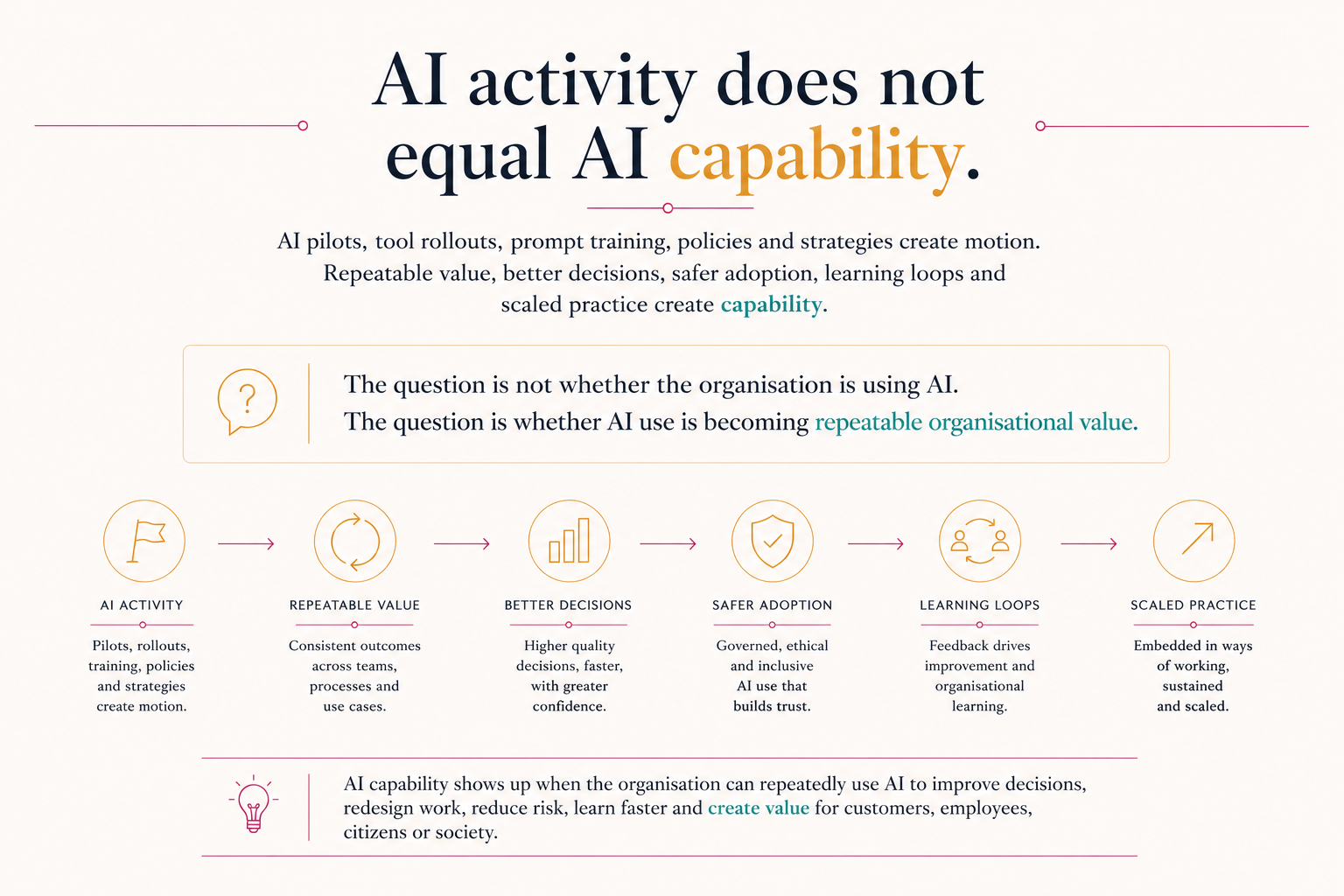
The question is not whether the organisation is using AI.
The question is whether AI use is becoming repeatable organisational value.
Why governance, data and trust are not support functions
AI creates value only when people, work, data, governance, learning and operating conditions move together.
This is why AI transformation exposes the capability gap so clearly.
- If the data is poor, people cannot trust the output.
- If governance is unclear, people do not know what is safe.
- If decision rights are missing, pilots stall.
- If leadership asks for innovation but rewards certainty, learning stops.
- If work is not redesigned, AI becomes another layer on top of an already overloaded system.
In that context, governance is not bureaucracy.
It is part of capability.
Data is not infrastructure alone.
It is part of capability.
Trust is not culture decoration.
It is part of capability.
Leadership is not communication.
It is part of capability.
Capability Architecture makes these connections visible.
It asks how the organisation designs the conditions that allow people and technology to create value together.
From three logics to one shared value system
Most organisations still operate through three separate logics.
HR focuses on people: skills, learning, culture, leadership and employee experience.
Business focuses on value: direction, priorities, outcomes, customers and performance.
Technology focuses on systems: data, infrastructure, security, platforms and AI.
Each logic is necessary.
Each is led by serious people doing real work.
But when the three logics are disconnected, they create fragmentation.
- HR delivers programmes.
- Business demands outcomes.
- Technology implements tools.
Everyone is active.
But the effort does not compound.
This is why better coordination is not enough.
The deeper issue is that the organisation does not share one language for value.
Capability Architecture connects the three logics around one question:
"What must we become able to do, repeatedly, to create the value that matters?"
That question gives HR, business and technology a shared object of design.
- Not a programme.
- Not a platform.
- Not a workshop.
A capability.
What Capability Architecture designs
Capability Architecture is not abstract.
It designs the conditions through which intent becomes repeatable value.
A practical Capability Architecture includes seven connected elements.
1. Strategic intent
What value is the organisation trying to create, and why does it matter?
This is not only a statement of ambition. It is the direction that capability must serve.
2. Capability map
What must the organisation become able to do, repeatedly?
This is not a list of jobs or skills. It is a map of organisational abilities required to create value.
3. Work and roles
Where does this capability need to live in real work?
Which workflows, decisions, roles, teams and handovers shape whether capability forms or breaks?
4. Skills and judgement
What must people, teams and leaders be able to understand, decide and do?
This includes technical skill, human judgement, ethical responsibility and the ability to work with AI in context.
5. Systems and conditions
What enables repeatable action?
Time. Trust. Mandate. Data. Tools. Governance. Psychological safety. Incentives. Leadership. Decision rights.
These are not soft conditions around capability.
They are the architecture of capability.
6. Feedback loops
How does the organisation know whether capability is forming, holding or breaking?
If capability lives in real work, the feedback loops must stay close to real work. Training completion, adoption metrics and generic engagement scores are not enough. Leaders need signals that show whether the organisation is actually becoming more able.
7. Value evidence
What improves for customers, employees, citizens, society or the business?
Capability only matters if it creates value. The final question is not whether activity happened. It is whether the organisation became able to create value more reliably.
A practical example: when AI pilots do not become capability
Imagine a company with a clear AI ambition.
The executive team wants AI to improve productivity, customer experience and decision quality. The technology team launches a secure AI platform. HR provides training. Several teams run pilots. Engagement is high.
On the surface, the transformation is moving.
But six months later, the value is still concentrated in the same few teams. The strongest pilots depend on the same three people. Other teams are interested but unsure. Some employees use AI quietly. Some avoid it entirely. Managers do not know what good looks like. Legal and risk teams are brought in too late. Learning is not captured. Workflows remain unchanged.
The organisation has AI activity.
But not yet AI capability.
A Capability Architecture lens would ask different questions:
- What capability are we actually trying to build?
- Where must it live?
- Which decisions should AI improve?
- Which workflows need redesign?
- What data needs to be trusted?
- What conditions do people need in order to use AI responsibly?
- How will we know whether capability is spreading beyond the first enthusiastic teams?
- What value should become visible if this capability is forming?
This is the shift.
Not more pilots.
Better architecture.
The leadership implication
Capability Architecture changes the leadership task.
Leaders need to stop asking only:
- Are people trained?
- Are tools adopted?
- Are projects launched?
- Are pilots running?
- Are stakeholders aligned?
And start asking:
- What must we become able to do?
- Where does that ability need to live?
- What conditions make it repeatable?
- What work must change?
- What should AI amplify?
- What tells us capability is actually forming?
- Where is value leaking?
This is not transformation theatre.
It is transformation that holds.
The future-ready organisation will not be the one with the most activity.
It will not simply be the one with the most advanced AI tools, the largest skills programmes or the boldest transformation strategy.
It will be the one that can turn ambition into capability.
And capability into value.
Capability Architecture as a new leadership discipline
Capability Architecture is the discipline organisations now need because the old assumptions are breaking.
The industrial organisation divided work for efficiency. The AI-era organisation must recombine work around value.
The old transformation logic asked whether people were aligned. Capability Architecture asks whether the organisation has become able.
The old skills logic asked what individuals need to learn. Capability Architecture asks what shared ability must form.
The old AI logic asked what technology can automate. Capability Architecture asks what human and organisational capability AI should amplify.
This is why Capability Architecture sits between strategy, HR, technology, innovation and transformation.
Not as another function.
As a shared discipline.
- The business owns the value.
- Technology enables the infrastructure.
- HR and people leaders shape the conditions.
- Leadership connects the system.
No single function owns capability alone.
But someone has to architect it.
Closing: the work between people
If humans are still part of the future organisation, human capability cannot be treated as a side effect of AI transformation.
It has to be designed into the system from the start.
- Capability does not live in a strategy deck.
- It does not live in a skills taxonomy.
- It does not live in a platform.
- It does not live in a pilot.
It lives between people.
Around value.
Through coordinated action.
Capability Architecture gives leaders a way to design that deliberately.
Because most organisations do not fail because they lack ambition.
They fail because ambition does not become capability.
And in the AI era, that gap is becoming too visible to ignore.