Innovation Activity is not Capability
By Deana Nannskog
Most organisations can point to their innovation activity. What is harder to point to is the capability: the system ability to turn uncertainty into value, not once, not in the hero project, but repeatedly, across functions, over time.
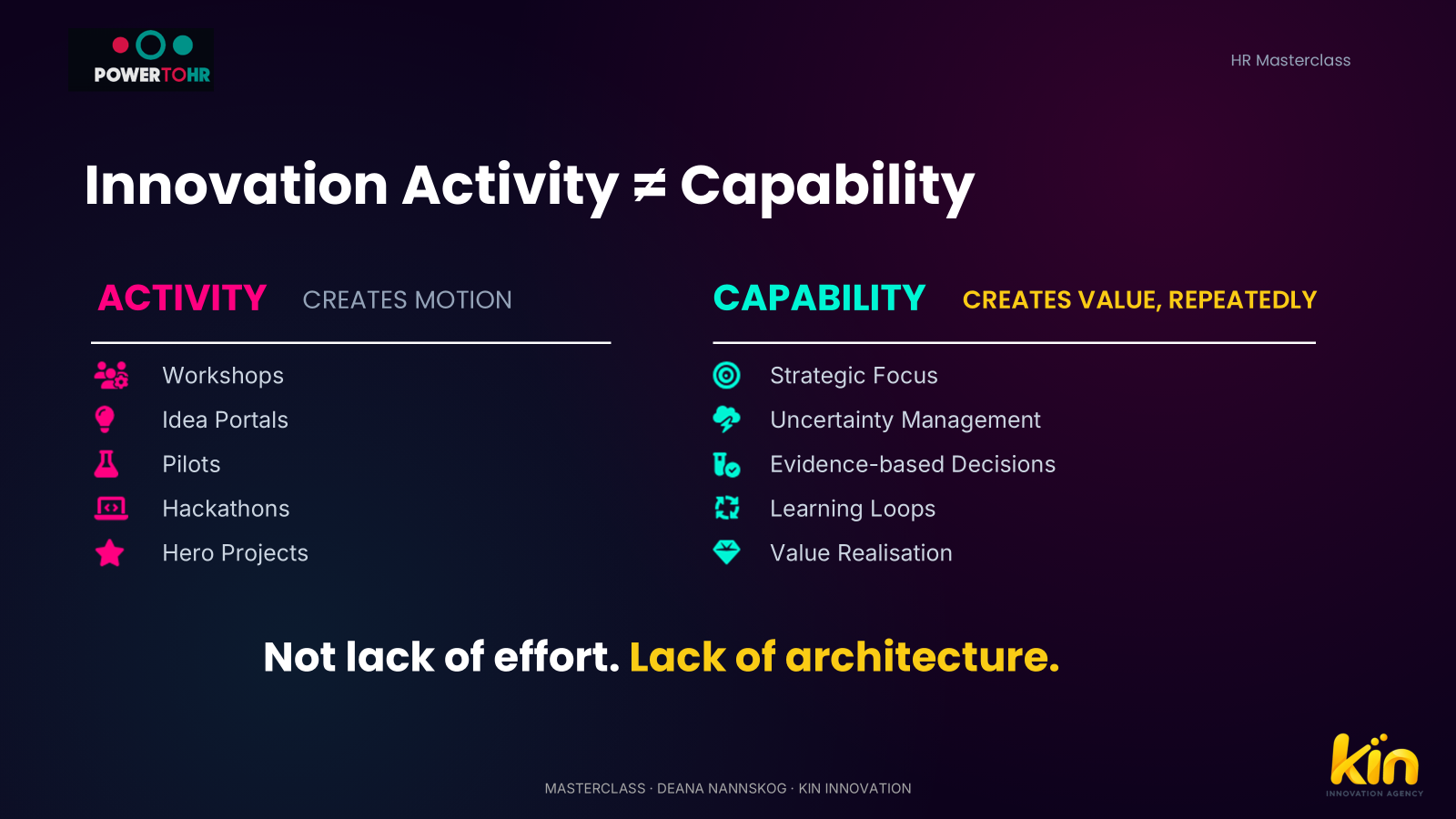
Most organisations can point to their innovation activity. Workshops running. An idea portal somewhere. A couple of pilots under way. A hackathon from last quarter. And somewhere in the organisation, the hero project that everyone is talking about.
What is harder to point to is the capability. The system ability to take uncertainty and turn it into value, not once, not in the hero project, but repeatedly, across functions, over time.
What activity actually creates
Innovation activity creates motion. It signals intent, builds energy and demonstrates that something is happening. These things matter. Organisations that do not run pilots do not learn from them. Organisations that do not create space for ideas do not surface them.
But motion is not capability. The workshops end and the insight stays in the room. The idea portal fills with submissions that are never prioritised. The pilot proves the concept and then stalls at scale. The hackathon produces great prototypes that no one implements. The hero project works because the right three people were in the room, and does not work again when those people are not.
What capability actually requires
Capability is different in kind, not just in degree. Where activity creates isolated events, capability creates repeatable systems. Five components make the difference:
- Strategic Focus: clarity about where innovation effort should concentrate. Without it, energy disperses across too many directions to compound into anything significant. Everyone is active. Nothing accumulates.
- Uncertainty Management: the ability to work productively with incomplete information, to make decisions, test assumptions and move forward without waiting for certainty that will not arrive.
- Evidence-based Decisions: mechanisms that translate learning into decisions. Not gut instinct, not consensus, but a systematic ability to read what is working and act on it before the window closes.
- Learning Loops: processes that turn experience into organisational knowledge. What did the pilot reveal? What does the prototype tell us? How does that change what we do next, not just for this project, but for how the organisation works?
- Value Realisation: the ability to convert what was learned, built or discovered into actual value for the organisation. This is where most innovation activity fails, at the final step from proof to impact.
The architecture gap
"Not lack of effort. Lack of architecture."
The difference between organisations that build innovation capability and those that generate innovation activity is not ambition, budget or talent. It is architecture, the deliberate design of the systems that connect activity to learning, learning to decisions, and decisions to value.
Most organisations have more than enough activity. The question worth asking honestly is: does our activity connect into a system? Is what we are doing today building something that will make the organisation more capable tomorrow?
Activity answers: are we doing something? Capability answers: are we becoming something? Innovation requires the second, and it does not arrive by accident.
References
- Chesbrough, H. W. (2003). Open innovation: The new imperative for creating and profiting from technology. Harvard Business School Press.
- Christensen, C. M. (1997). The innovator's dilemma: When new technologies cause great firms to fail. Harvard Business School Press.
- Dougherty, D., & Hardy, C. (1996). Sustained product innovation in large, mature organizations: Overcoming innovation-to-organization problems. Academy of Management Journal, 39(5), 1120–1153. https://doi.org/10.2307/256994
- ISO. (2019). ISO 56002:2019 Innovation management - Innovation management system - Guidance. International Organization for Standardization.
- Tidd, J., & Bessant, J. R. (2021). Managing innovation: Integrating technological, market and organizational change (7th ed.). Wiley.