Capability is shared ability
By Deana Nannskog
Most definitions of capability point inward: skills, competencies, qualifications, things that live inside individuals. But capability, properly understood, does not live inside people. It lives between them.
Most definitions of capability point inward. Skills, competencies, qualifications, things that live inside individuals. We assess them, develop them, map them to roles. We build frameworks to describe them and platforms to track them.
But capability, properly understood, does not live inside people. It lives between them.
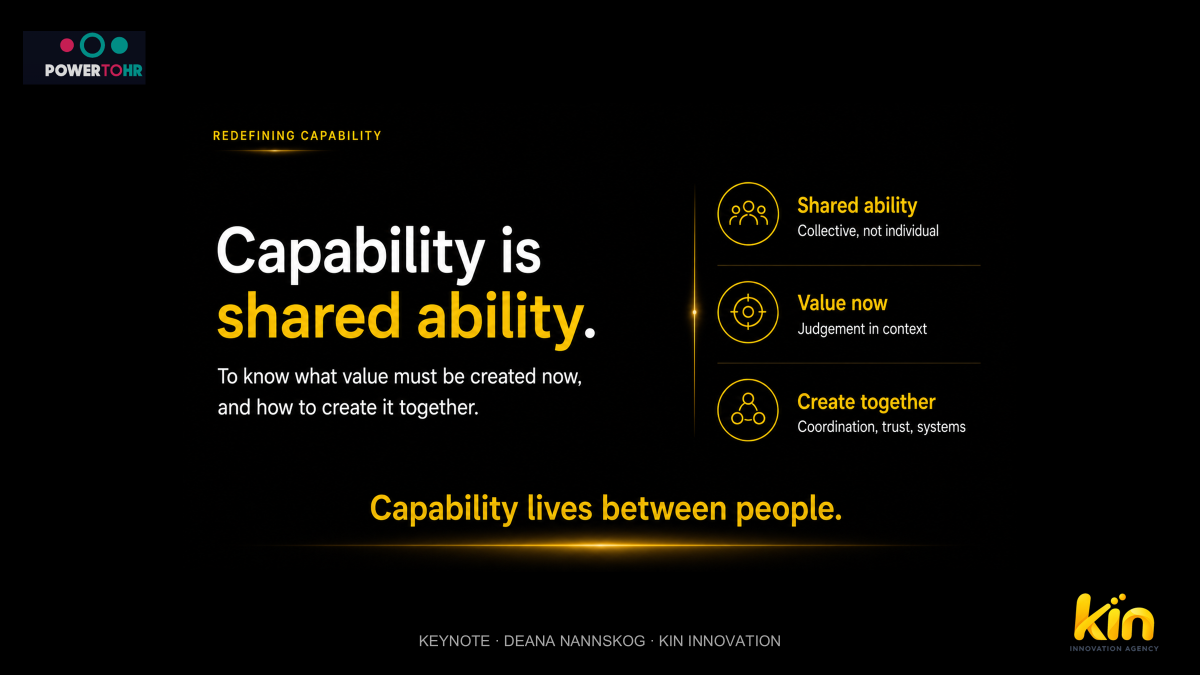
Redefining capability
"Capability is the shared ability to know what value must be created now, and how to create it together."
Deana Nannskog
Three things make that definition real:
- Shared ability, collective, not individual. Capability exists when a group can reliably do something together that creates value. Not when individuals possess skills that sit unused or unconnected from the work that matters.
- Value now, judgement in context. Capability is not abstract or timeless. It is oriented toward a specific value that matters in this situation, for these people, with these constraints. The ability to make good decisions in the right direction, now, not in theory.
- Create together, coordination, trust, systems. Getting from intent to value requires people who can coordinate, structures that allow them to act, and systems that help them learn and improve from what happens.
What this changes
When capability is understood as shared ability, the questions leaders ask change.
- Instead of: what skills do our people have? The question becomes: what can we reliably do together that creates value?
- Instead of: who is responsible for capability development? The question becomes: what conditions are we creating for shared capability to grow?
- Instead of: how do we assess individual competence? The question becomes: how do we design for collective ability?
These are not just reframings. They lead to different investments, different designs, and different measures of whether capability is actually building.
Capability lives between people
This is not a philosophical distinction. It has practical consequences.
When capability is treated as individual, organisations invest in developing people and then wonder why organisational performance does not improve proportionally. People get better. The training scores go up. The survey results improve. But the shared ability to create value together, which depends on coordination, trust, shared language, and how work actually flows, stays unchanged.
Capability that lives between people requires design. Not just training programmes and competency frameworks, but deliberate attention to how people connect, how direction flows, how decisions get made, and how learning circulates. These are not HR activities that happen alongside the work. They are the conditions that make the work possible.
"Capability lives between people."
Which means building capability requires designing the space between people, not just developing what is inside them.
References
- Hutchins, E. (1995). Cognition in the wild. MIT Press.
- Nannskog, Deana. (2025). Capability is the shared ability to know what value must be created now, and how to create it together [Original definition]. Kin Innovation Agency.
- Sen, A. (1999). Development as freedom. Oxford University Press.
- Vygotsky, L. S. (1978). Mind in society: The development of higher psychological processes (M. Cole, V. John-Steiner, S. Scribner, & E. Souberman, Eds.). Harvard University Press.
- Wenger, E. (1998). Communities of practice: Learning, meaning, and identity. Cambridge University Press.