From intent to value: why most capability investments miss the point
By Deana Nannskog
Organisations are investing more in capability development than ever before. Learning platforms, AI tools, transformation programmes, skills initiatives, leadership academies. Billions invested. Capability still missing. The problem is not effort. It is design.
On 8 September 2025, Kosovo beat Sweden 2-0 in FIFA World Cup qualifying. Sweden had 68.3% possession. Three weeks later, Sweden hosted Kosovo. Same result. Kosovo 1-0. Sweden possession: 67.4%.
"Sweden had the ball. Kosovo had the result."
Possession is activity. Results are capability. And the gap between the two is not closed by doing more of the same thing.
The paradox that nobody talks about
Organisations are spending more on capability development than ever before. Learning platforms. AI tools. Transformation programmes. Skills initiatives. Leadership academies. The investment is real. The intent is genuine.
Billions invested. Capability still missing.
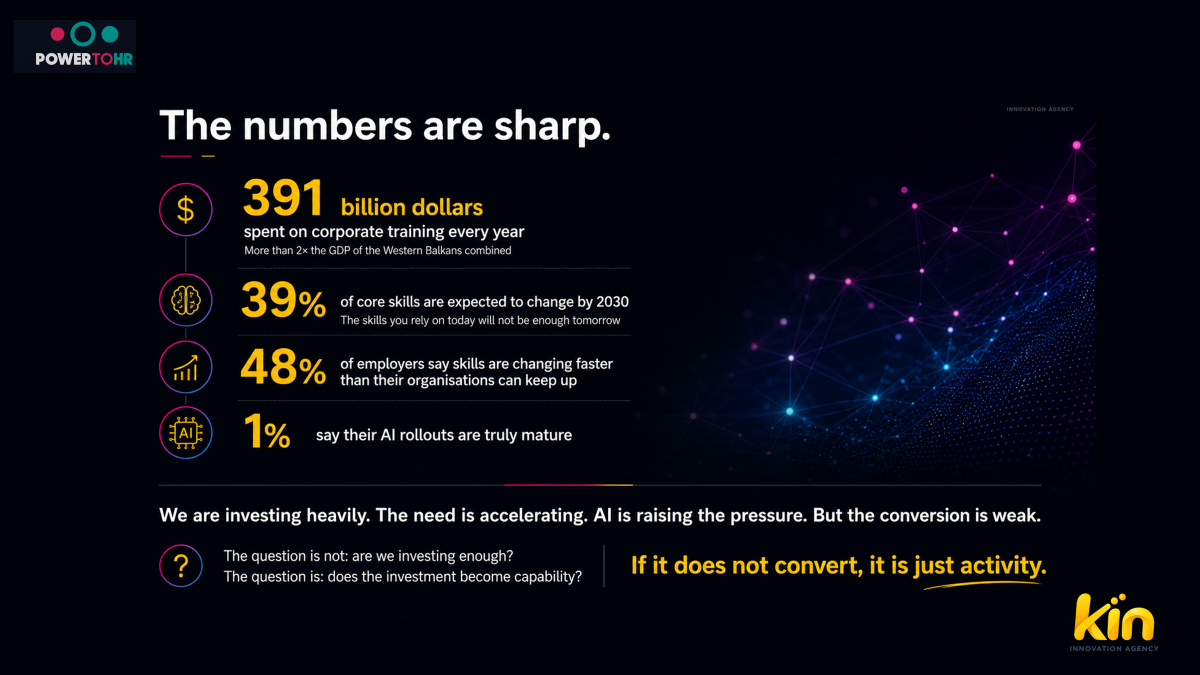
According to the World Economic Forum's Future of Jobs Report 2025, employers expect 39% of core skills to change by 2030. Despite massive investment in upskilling, reskilling and transformation, most organisations still struggle to convert learning into sustained organisational capability.
It is not that organisations are doing nothing. They are doing a great deal. The problem is that most of it stays at the level of intent: good plans, smart ideas, well-funded programmes, without ever converting into the real organisational ability to do something differently. McKinsey's research on large-scale transformation consistently finds that success depends not on skills or training alone, but on the organisation's ability to shift behaviours, systems and execution conditions at scale, and to sustain that shift over time.
What lives between intent and value?
The gap between intent and value is not a motivation problem. It is not a talent problem. It is a design problem, and it has a specific shape. Four things need to exist for intent to become value:
- Shared language: people across the organisation need to describe what they are trying to build in the same terms. Without this, alignment is assumed rather than real. Decisions slow down. Priorities conflict. Everyone is technically working on the same strategy but pulling in different directions.
- Capability Architecture: the deliberate design of what the organisation must become able to do, where that capability needs to live, and what conditions make it repeatable. Not a competency framework. Not a training catalogue. A design discipline.
- Conditions for agency: people need enough direction, enough decision-making authority, and enough psychological safety to act rather than wait. Without these conditions, capability that exists in individuals never becomes capability that belongs to the organisation.
- Feedback loops: mechanisms that show whether capability is actually growing, not just whether activity is happening. Most organisations measure inputs and outputs. Few measure capability accumulation.
Why intent does not become value on its own
Intent is directional. Value is structural. Strategy points toward a future state. Capability architecture determines whether the organisation can repeatedly move toward it under real conditions, with real people, across time. Research into dynamic capabilities and enterprise architecture increasingly points toward the same conclusion: transformation succeeds when strategy, technology, processes and organisational learning are deliberately connected into repeatable systems, not managed as separate workstreams.
This is why an organisation can be running a transformation programme, a skills initiative, an AI rollout and a leadership development curriculum simultaneously, and still find itself in the same position two years later. Each initiative may be well-designed in isolation. But without the design layer that connects them to organisational capability, nothing compounds.
Sweden did not lose because their players lacked skill. They lost because skill and possession did not translate into what the game required: goals. The organisation had the inputs. It lacked the architecture to convert them.
The question that closes the gap
The question is not: are we investing enough? Most organisations are. The question is: are we designing the right things?
That means being honest about which capabilities the strategy actually requires, where they need to live in the organisation, what conditions currently prevent them from becoming reliable, and whether the measures you have show capability or just activity.
From intent to value is never a communication exercise. It is a capability design challenge. The organisations that succeed in the AI era will not necessarily be the ones investing the most in tools, training or transformation programmes. They will be the ones able to deliberately design the human, organisational and systemic conditions that allow capability to accumulate and translate into value over time.
References
- Kaplan, R. S., & Norton, D. P. (2008). The execution premium: Linking strategy to operations for competitive advantage. Harvard Business Press.
- McKinsey Global Institute. (2023). The economic potential of generative AI: The next productivity frontier. McKinsey & Company.
- Nannskog, Deana. (2025). Capability is shared ability. www.nannskog.com. https://www.nannskog.com/thinking/capability-is-shared-ability
- Teece, D. J., Pisano, G., & Shuen, A. (1997). Dynamic capabilities and strategic management. Strategic Management Journal, 18(7), 509–533. https://doi.org/10.1002/(SICI)1097-0266(199708)18:7<509::AID-SMJ882>3.0.CO;2-Z
- World Economic Forum. (2025). The future of jobs report 2025. World Economic Forum.