Capability architecture, in practice
Most organisations have intent. Many have values. Very few have architecture, the structure that makes it possible to get from intent to value reliably, rather than occasionally.
Most organisations have intent. Many have values. Very few have architecture.
Intent is what leadership says must change. Value is the outcome that matters. Architecture is everything in between, the structure that makes it possible to get from one to the other reliably, rather than occasionally.
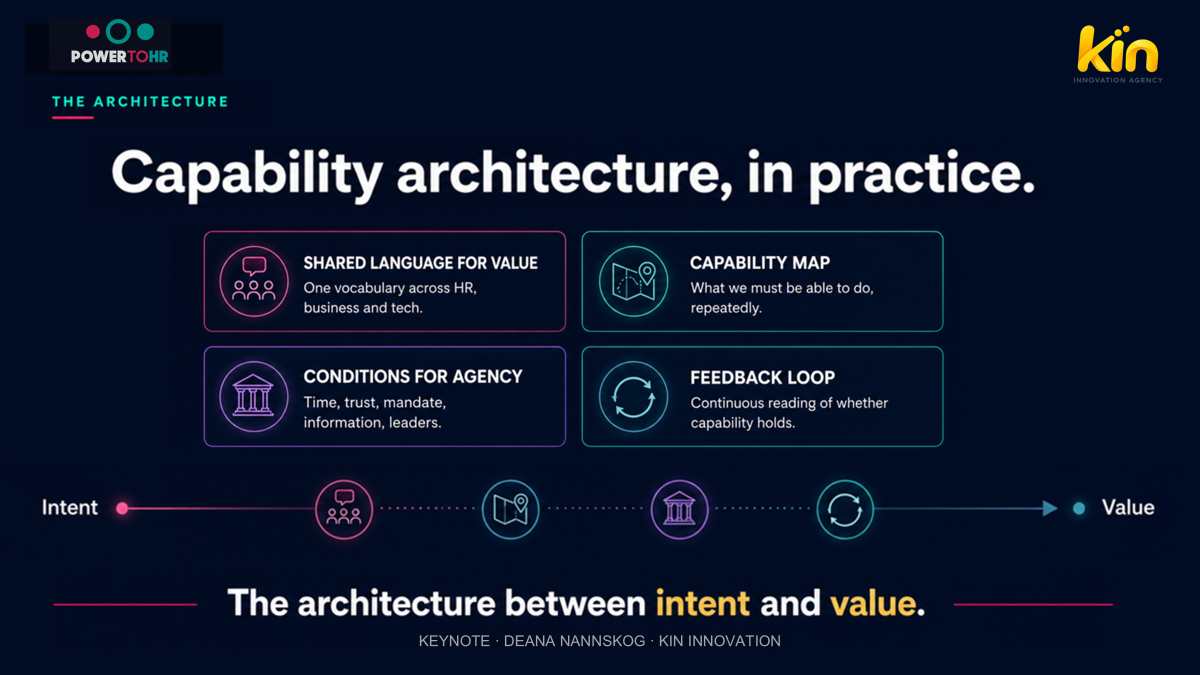
Four components. One system.
Capability architecture, as I use the term, is the design of four interconnected components that together make it possible for an organisation to build and sustain the ability to create value. They form a sequence, from the social to the structural to the enabling to the learning.
- Shared language for value, one vocabulary across HR, business and technology. Without it, each function operates on its own definition of what capability means and what matters. Alignment becomes impossible because people are not arguing about decisions; they are arguing about definitions. A shared language is not a glossary. It is a common frame for what the organisation exists to do and what it must be able to do to do it.
- Capability map, what we must be able to do, repeatedly. Not a competency framework. A capability map describes the organisational abilities that, if built and sustained, would allow the organisation to create the value it intends. It is built from the value back, not from the job architecture forward. It answers one question: what must we be reliably able to do?
- Conditions for agency, time, trust, mandate, information, leaders. Capability does not build itself. People need conditions in which they can act: enough time to learn without it being stolen by urgency; trust that makes it safe to try and fail; mandate to make decisions at the right level; information that makes those decisions possible; and leaders who create rather than block the space for capability to develop.
- Feedback loop, continuous reading of whether capability holds. Architecture without feedback is static. The feedback loop is the mechanism by which the organisation reads whether capability is actually building, not through annual surveys, but through continuous signals: what is being done, how well, at what cost, and whether the organisation is becoming more able over time.
Architecture between intent and value
These four components are not independent. Shared language makes it possible to build a meaningful capability map. The capability map points to the conditions that need to be in place. The feedback loop tells you whether those conditions are working and where the map needs to change. The system is circular, which is the point. Capability architecture is not a project with an end date. It is a design you maintain and improve as the organisation and its environment change.
Most organisations have some of these components, partially. A competency framework that approximates a capability map. Some leaders who create conditions for agency. Occasional reviews that function as feedback. The problem is not that the elements are absent, it is that they are disconnected. Without architecture connecting them, each component does partial work. The gap between intent and value stays open.
Most organisations have intent. Very few have the architecture to get from intent to value reliably.
References
- Day, G. S. (1994). The capabilities of market-driven organizations. Journal of Marketing, 58(4), 37–52. https://doi.org/10.2307/1251915
- Helfat, C. E., & Peteraf, M. A. (2003). The dynamic resource-based view: Capability lifecycles. Strategic Management Journal, 24(10), 997–1010. https://doi.org/10.1002/smj.332
- Prahalad, C. K., & Hamel, G. (1990). The core competence of the corporation. Harvard Business Review, 68(3), 79–91.
- Zollo, M., & Winter, S. G. (2002). Deliberate learning and the evolution of dynamic capabilities. Organization Science, 13(3), 339–351. https://doi.org/10.1287/orsc.13.3.339.2780