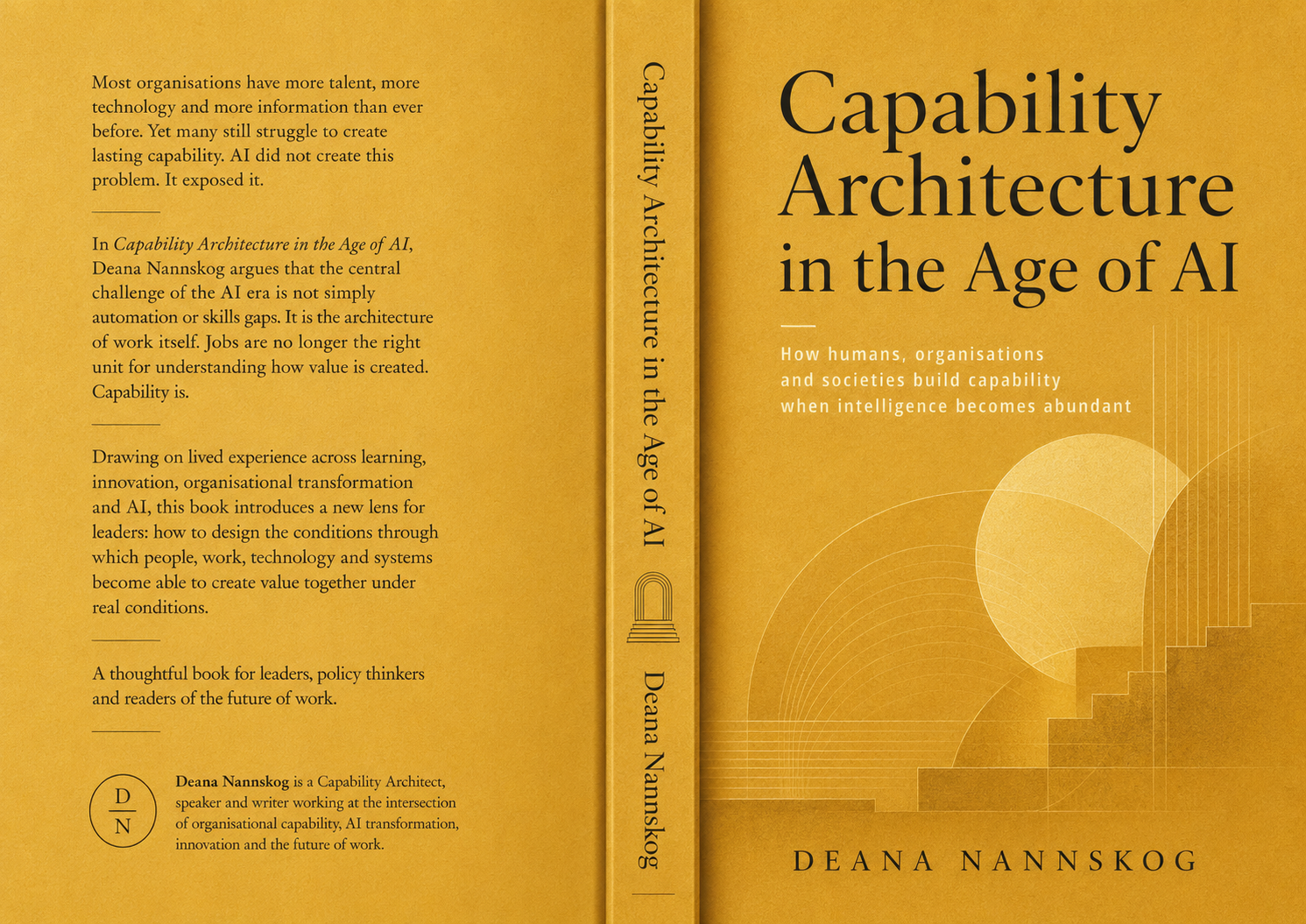
Capability Architecture
in the Age of AI
How humans, organisations and societies build capability when intelligence becomes abundant.
An upcoming non-fiction book by Deana Nannskog on organisational capability, AI transformation and the future of work.
The Central Problem
Most organisations have more talent, more technology and more information than ever before.
Yet many still struggle to create lasting capability.
AI did not create this problem. It exposed it.
Organisations that survive and thrive in the AI era are those that deliberately design their capability architecture — the connection between intention, capability, roles and the systems that enable value.
The central challenge of the AI era is not automation or skills gaps. It is the architecture of work itself.
About the Book
A journey across disciplines
This book asks why organisations with talent, technology and ambition still struggle to become capable of doing what the future requires.
It follows a question that runs through lifelong learning, organisational design, innovation systems, AI transformation and the future of work: what makes a person, team, organisation or society genuinely capable of creating value under changing conditions?
The book argues that AI is not simply changing jobs. It is exposing a deeper architectural problem in how organisations understand work, capability and value.
This is not an academic bibliography. It is a journey.
What is Capability Architecture?
Capability Architecture is the practice of designing the conditions for collective value creation.
Capability Architecture is the practice of designing the conditions through which people, work, technology and systems become able to create value together under real conditions.
It connects strategy to the shared abilities an organisation must build, govern and evolve. It asks not only what people need to know, but what the organisation must become able to do, repeatedly, in context and under pressure.
What is organisational capability?
Organisational capability is the shared ability of an organisation to create value repeatedly.
Organisational capability is the shared ability of an organisation to create value repeatedly under real conditions.
It is not the same as individual skills, job titles, roles or activity. Capability lives in the connections between people, work, systems, technology, decisions, trust and value. A capable organisation is not simply one with capable individuals. It is one where conditions allow individual knowledge, judgement and agency to become collective performance.
Why AI exposes the capability problem
AI increases access to intelligence. It also reveals whether an organisation knows what to do with it.
When those conditions are missing, AI can create more activity without creating more capability.
AI increases access to intelligence, automation and analysis. But it also exposes whether an organisation knows what value it is trying to create, where judgement sits, how work should be redesigned and whether people have the mandate, trust and systems to act well. The organisations that thrive in the age of AI will not be those with the most AI activity. They will be those that deliberately design, build, govern and renew capability.
The Framework
Three horizons, one coherent logic
The book explores capability across three simultaneous horizons: the capability to deliver what matters now, the capability to adapt as conditions change and the capability to rebuild for what comes next.
These are not phases in a transformation programme. They are parallel organisational logics.
Horizon I
Deliver Today
Optimise and deliver effectively with existing capability. Focus on operational excellence, clear roles and processes that work now.
Horizon II
Adapt Tomorrow
Build new capability and learning capacity in parallel with delivery. Identify emerging capabilities and invest in reshaping roles and competencies.
Horizon III
Rebuild for What Comes Next
Challenge fundamental assumptions about how work is organised. Design the organisation, roles and systems from a fundamentally new logic driven by AI and changing value chains.
Inside the Book
Twelve chapters, five parts
The book moves from diagnosis to architecture to motion — from what is broken, through what must be designed, to what a genuinely capable organisation looks and feels like.
The Organisation No Longer Knows What It Can Do
Most organisations can describe what they do. Fewer can honestly say what they are capable of under new conditions. This chapter examines how accumulated complexity and the separation of work from value have left many organisations genuinely uncertain about their own capability — and why that uncertainty is dangerous precisely when conditions change fast.
We Have Been Using the Wrong Units
The language of skills, jobs and roles was built for a different era of work. This chapter argues that individual competencies are the wrong unit for understanding organisational performance and that the gap between individual talent and collective capability is where most transformation efforts quietly fail.
Capability Begins with Contribution, Not Performance
Performance is what happened. Capability is what an organisation becomes able to do. This chapter proposes a different starting point: not the appraisal of past performance, but the design of conditions in which people can make their best contribution to shared goals under real conditions.
Judgement, Trust and Real Conditions
Capability cannot be separated from the conditions in which it must be exercised. This chapter examines the roles of judgement, trust and context in determining whether individual knowledge becomes collective action — and why organisations that remove discretion in the name of efficiency often remove capability in the process.
Intent: What Must We Become Able to Do?
Every capability architecture begins with a question: what must this organisation become able to do that it cannot do today? This chapter introduces capability intent as the strategic starting point for designing organisations that can adapt and deliver under changing conditions.
Where Capability Lives
Capability does not reside in people alone. It lives in the space between people, work, systems, technology and decisions. This chapter maps the structures, relationships and enabling conditions through which organisational capability actually forms and operates.
Systems and Conditions
The most capable individuals in a poorly designed system will underperform. This chapter examines how governance, accountability, information flow and work design either enable or constrain the capability of the people within them.
From Capability to Value
Capability is not an end in itself. It is the means by which an organisation creates value for the people, communities and systems it serves. This chapter closes the loop between capability architecture and the ultimate purpose of organisational life: creating value that matters under conditions that change.
Deliver, Adapt and Rebuild
Organisations must operate across three simultaneous horizons: delivering what matters now, adapting as conditions shift and rebuilding for what comes next. This chapter argues that these are not sequential phases but parallel demands — and that capability architecture must hold all three together.
The Capability Organisation
What does an organisation that takes capability seriously actually look like? This chapter draws the architecture together into a coherent picture of an organisation designed not just to perform, but to become increasingly able under pressure, uncertainty and change.
From Organisational to Societal Capability
Capability does not stop at the boundaries of a firm. This chapter extends the argument outward to consider how cities, education systems, policy structures and public institutions either develop or destroy the collective capability of the societies they serve.
The Age of Abundant Intelligence
As AI makes intelligence cheaper and more accessible, the question of capability becomes urgent in a new way. This chapter considers what it means for humans, organisations and societies to remain genuinely capable of creating value when intelligence itself is no longer scarce.
For Publishers and Literary Agents
A serious non-fiction project in progress
The manuscript is currently in development. Deana Nannskog is available for thoughtful conversations with publishers, literary agents, editors and media partners interested in Capability Architecture, organisational capability, AI transformation and the future of work.
This is a serious non-fiction project in progress, developed from lived professional experience, research, organisational practice and emerging public thought leadership.
Status
Working manuscript — actively being written
Expected publication
Spring 2027
Audience
Senior leaders, organisational transformation leaders, CHROs, innovation leaders, AI transformation leaders, policy thinkers and readers interested in the future of work
Available on request
- Book overview
- Chapter-by-chapter blurb
- Sample chapter
- Author credentials and media profile
- Book proposal (in preparation)
Speaking and Advisory Work
The book and the keynote reinforce each other
Speaking, consulting and writing are not separate activities. They are one coherent body of thought, developed in conversation with leaders across industries and continents.
For publishing, speaking or media enquiries, please get in touch.
deana@nannskog.com →