Pulse: the mirror, not the answer
Most innovation assessments answer the wrong question. They ask: how innovative are you? Pulse asks a different question entirely: can your system sustain innovation?
Most innovation assessments answer the wrong question. They ask: how innovative are you? And then they produce a score, a benchmark, a maturity level. Leaders look at the number. Wonder what to do with it. And move on.
Pulse, Kin's innovation system diagnostic, asks a different question: can your system sustain innovation? Not whether you have innovation ambition. Whether your infrastructure of conditions, capabilities and processes is designed to make innovation possible, repeatedly and without depending on the same three people every time.
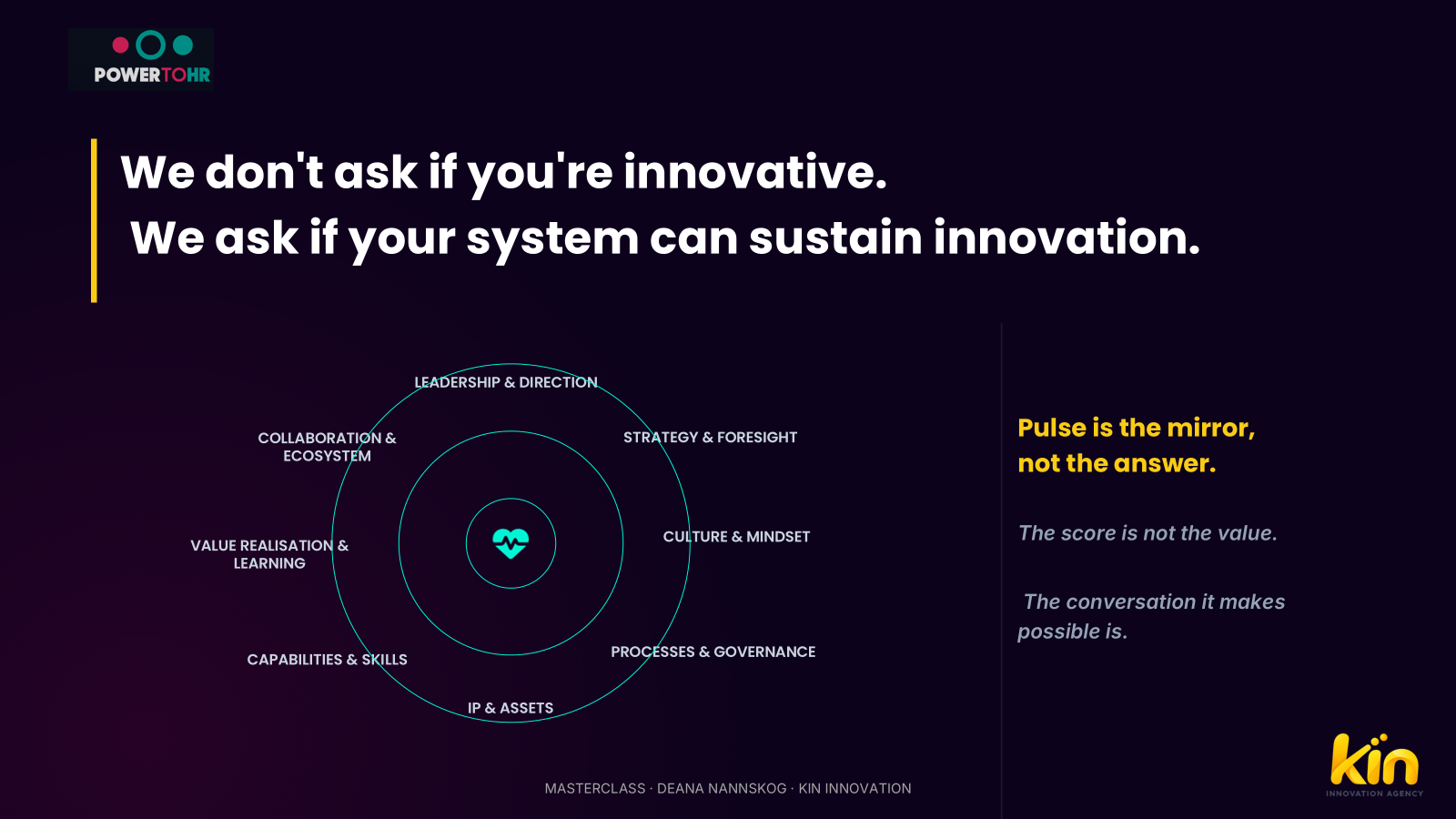
Nine dimensions, one system
Pulse measures nine dimensions of the innovation system, aligned with the ISO 56000 family. Not as a ranking, but as a map: a picture of where the system is strong, where it is fragile, and where the gaps between what leadership intends and what the system supports are widest.
- Leadership and Direction: Is innovation direction clear, prioritised and communicated with enough consistency for people to act on it?
- Strategy and Foresight: Is the organisation reading its environment and building the strategic insight that makes good innovation bets possible?
- Culture and Mindset: Are the everyday norms, beliefs and behaviours of the organisation consistent with the innovation it says it wants?
- Processes and Governance: Are there mechanisms for moving ideas from exploration to decision, and decisions to action, without losing momentum?
- IP and Assets: Is the organisation capturing, protecting and deploying what it creates, including the knowledge that lives in people and practice?
- Capabilities and Skills: Do people have what they need to do innovation work well, not just technical skills, but the collaboration and sensemaking skills that make uncertainty workable?
- Value Realisation and Learning: Does innovation effort result in value, and does the organisation learn from both success and failure, systematically, not accidentally?
- Collaboration and Ecosystem: Is the organisation effectively connecting to the external knowledge, talent and relationships that expand what is possible?
The mirror, not the answer
"Pulse is the mirror, not the answer."
The score Pulse produces is not the output. The conversation it makes possible is.
Most organisations already know, at some level, where their innovation system is weak. Pulse makes that knowledge specific, shared and visible in a way that allows it to be discussed rather than avoided. The mirror shows what is there. The value is in what the organisation chooses to do about it.
A high score does not mean the organisation is innovative. It means the conditions for sustained innovation are in place. A low score does not mean failure. It means there is a design gap between intent and infrastructure, and design gaps can be closed.
The score is not the value. The conversation it makes possible is.
References
- ISO. (2019). ISO 56002:2019 Innovation management - Innovation management system - Guidance. International Organization for Standardization.
- ISO. (2020). ISO 56000:2020 Innovation management - Fundamentals and vocabulary. International Organization for Standardization.
- OECD. (2018). Oslo manual 2018: Guidelines for collecting, reporting and using data on innovation (4th ed.). OECD Publishing. https://doi.org/10.1787/9789264304604-en
- Tidd, J., & Bessant, J. R. (2021). Managing innovation: Integrating technological, market and organizational change (7th ed.). Wiley.