Why ISO 56000 matters for innovation leaders
Innovation has long suffered from a language problem. Without shared vocabulary, conversations about resource allocation, strategic priority and how to measure progress become circular and inconclusive. The ISO 56000 family of standards is a significant step toward solving that.
Innovation has long suffered from a language problem. Organisations talk about it in terms that mean different things to different people. Creativity to one. Speed to market to another. Cultural change to a third. Without shared vocabulary, the conversations that matter, about resource allocation, strategic priority, how to measure progress, become circular and inconclusive.
The ISO 56000 family of standards represents a significant step toward solving that problem. Not by making innovation bureaucratic, but by creating a common language precise enough to have serious conversations about it.
What the standards actually provide
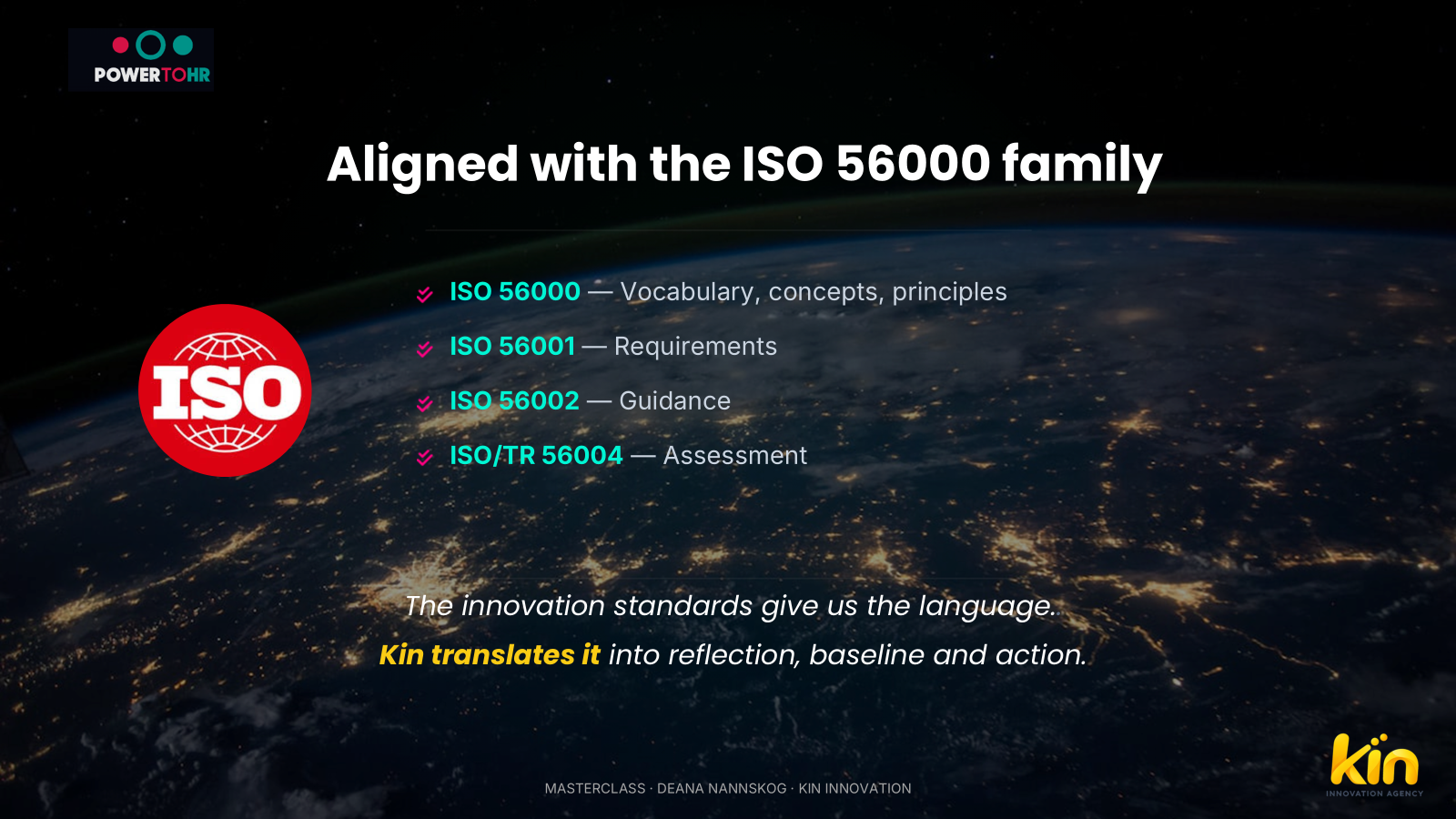
The ISO 56000 family was developed to give organisations a systematic, internationally agreed framework for managing innovation. Four standards form the core:
- ISO 56000 establishes the vocabulary, concepts and principles, a shared language for what innovation is, what its key terms mean, and the conceptual foundations the other standards build on.
- ISO 56001 sets out the requirements for an innovation management system, what an organisation needs to have in place to manage innovation in a structured, auditable way.
- ISO 56002 provides guidance for implementing those requirements, the how, not just the what, making the standard practical rather than abstract.
- ISO/TR 56004 covers assessment, how to evaluate an organisation's current innovation capability against the standard's dimensions, creating a baseline for improvement.
Together, they create a framework that makes innovation manageable: possible to describe, to measure, to improve. Not a guarantee of innovation. A system for building the conditions that make it more likely, and more repeatable.
Language before alignment
The most immediate value of the ISO 56000 family for organisations is not certification. It is vocabulary. When HR, strategy, technology and operations share a language for innovation, what it means, what its management requires, what capability looks like, alignment becomes possible in a way that good intentions alone never produce.
At Kin, we use the ISO 56000 family as the language for the work we do with clients. It gives us precision when we diagnose, when we design, and when we measure. Without a shared language, every engagement starts with definitional debate. With it, we can get to the real work faster.
The innovation standards give us the language. Kin translates it into reflection, baseline and action.
References
- ISO. (2019). ISO 56002:2019 Innovation management - Innovation management system - Guidance. International Organization for Standardization.
- ISO. (2019). ISO 56004:2019 Innovation management assessment - Guidance. International Organization for Standardization.
- ISO. (2020). ISO 56000:2020 Innovation management - Fundamentals and vocabulary. International Organization for Standardization.
- ISO. (2021). ISO 56003:2019 Innovation management - Tools and methods for innovation partnership - Guidance. International Organization for Standardization.
- OECD. (2018). Oslo manual 2018: Guidelines for collecting, reporting and using data on innovation (4th ed.). OECD Publishing. https://doi.org/10.1787/9789264304604-en