Four lenses to read the system
By Deana Nannskog
When innovation is not working, the instinct is to look for who is responsible. The more useful question is not who but where, which layer of the system is failing to enable the work that matters.
When innovation is not working, the instinct is to look for who is responsible. The team that did not deliver. The manager who blocked the initiative. The culture that resisted change. These observations are rarely entirely wrong, but they are almost always incomplete.
The more useful question is not who but where. Where in the system is the capability missing? Which part of the infrastructure is failing to enable the work that matters?
Reading signals, not blaming people
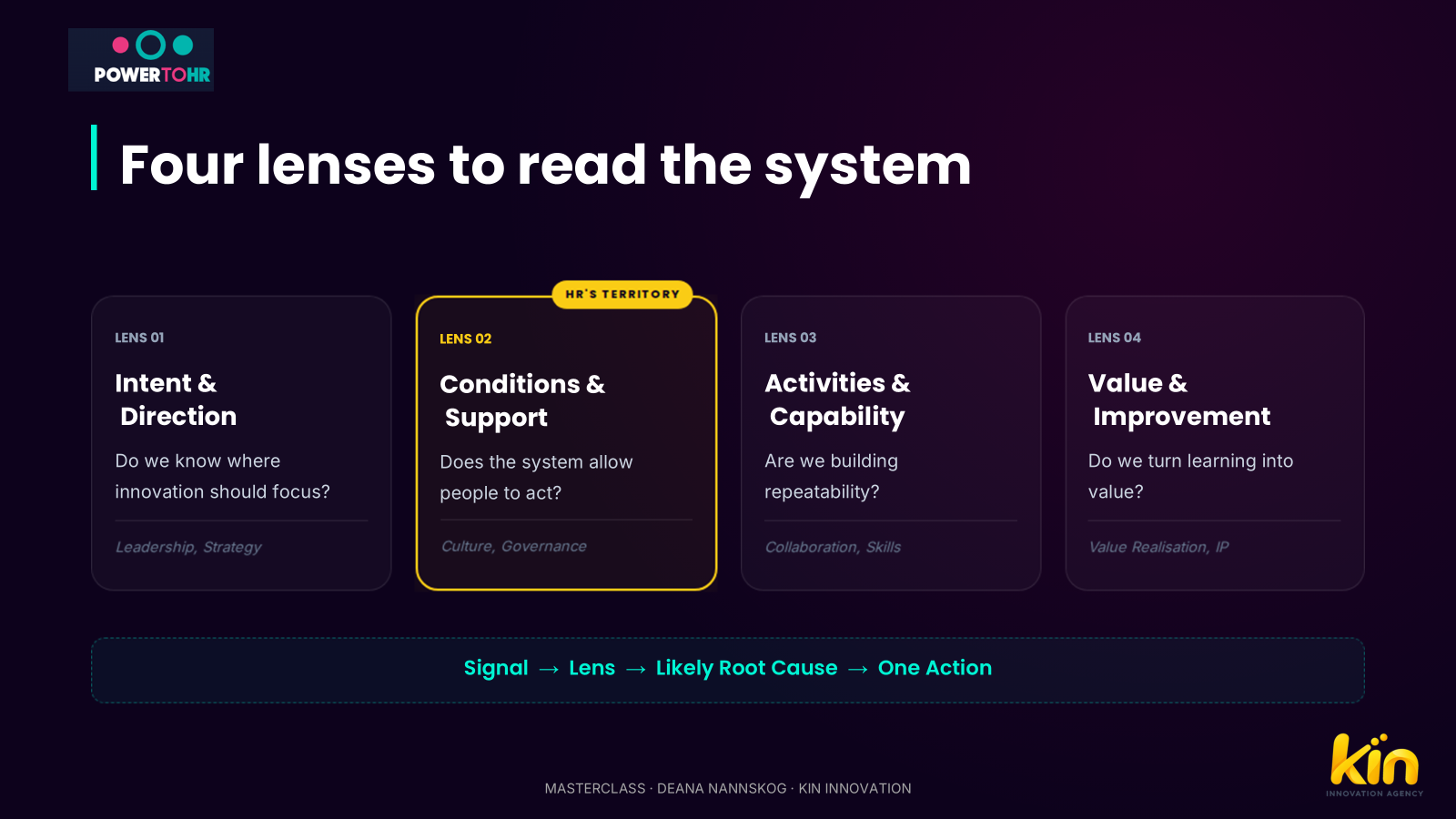
A system reading uses four lenses. Each lens corresponds to a layer of the innovation system. Each points to a different class of root cause. And each suggests a different class of action.
- Lens 01, Intent and Direction: Do we know where innovation should focus? Innovation without direction is not innovation, it is experimentation without consequence. This lens asks whether leadership has been clear enough about where the organisation is trying to go, and whether that direction translates into priorities people can actually act on. Sub-dimensions: Leadership, Strategy.
- Lens 02, Conditions and Support (HR's territory): Does the system allow people to act? This is the domain where HR makes decisions every day, psychological safety, time, governance, culture and mandate. Most innovation failures labelled as 'culture problems' are actually condition problems: specific, designable conditions that HR is in a position to change. Sub-dimensions: Culture, Governance.
- Lens 03, Activities and Capability: Are we building repeatability? This lens looks at what is actually happening: the processes, tools, skills and collaboration patterns that determine whether innovation effort compounds into capability or stays as isolated events. The question is not whether there is activity, but whether that activity is building anything that will last. Sub-dimensions: Collaboration, Skills.
- Lens 04, Value and Improvement: Do we turn learning into value? The final lens asks whether the organisation is closing the loop: capturing what was learned, converting it into improvement, and building the mechanisms that turn innovation effort into organisational value. Sub-dimensions: Value Realisation, IP.
Signal, lens, root cause, one action
"Signal. Lens. Likely Root Cause. One Action."
The diagnostic process is straightforward in principle. A signal appears, a pilot that stalled, a transformation that did not land, an initiative that produced a great slide deck and no change in behaviour. The lens tells you where to look. The root cause tells you what is actually missing. And one action is enough to start.
The reason four lenses rather than a comprehensive framework is deliberate. Comprehensive frameworks produce comprehensive analyses that no one implements. Four lenses produce a focused diagnosis, and a focused diagnosis produces a conversation, not a report.
Most innovation problems that look like people problems are system problems. And system problems become visible when you know where to look.
References
- Argyris, C., & Schön, D. A. (1978). Organizational learning: A theory of action perspective. Addison-Wesley.
- Senge, P. M. (1990). The fifth discipline: The art and practice of the learning organization. Doubleday.
- Tidd, J., & Bessant, J. R. (2021). Managing innovation: Integrating technological, market and organizational change (7th ed.). Wiley.
- Ulrich, D., & Brockbank, W. (2005). The HR value proposition. Harvard Business School Press.