Innovation capability lives or dies in HR's territory
By Deana Nannskog
Strategy declares intent. People deliver value. HR shapes the conditions in between. That makes HR the architect of innovation capability, whether HR knows it or not.
There is a diagram in my masterclass that tends to cause a moment of uncomfortable recognition. Three levels: strategic intent at the top, value creation at the bottom, and in between, the conditions. Six of them. Purpose. Trust. Time. Leadership. Tools. Mandate.
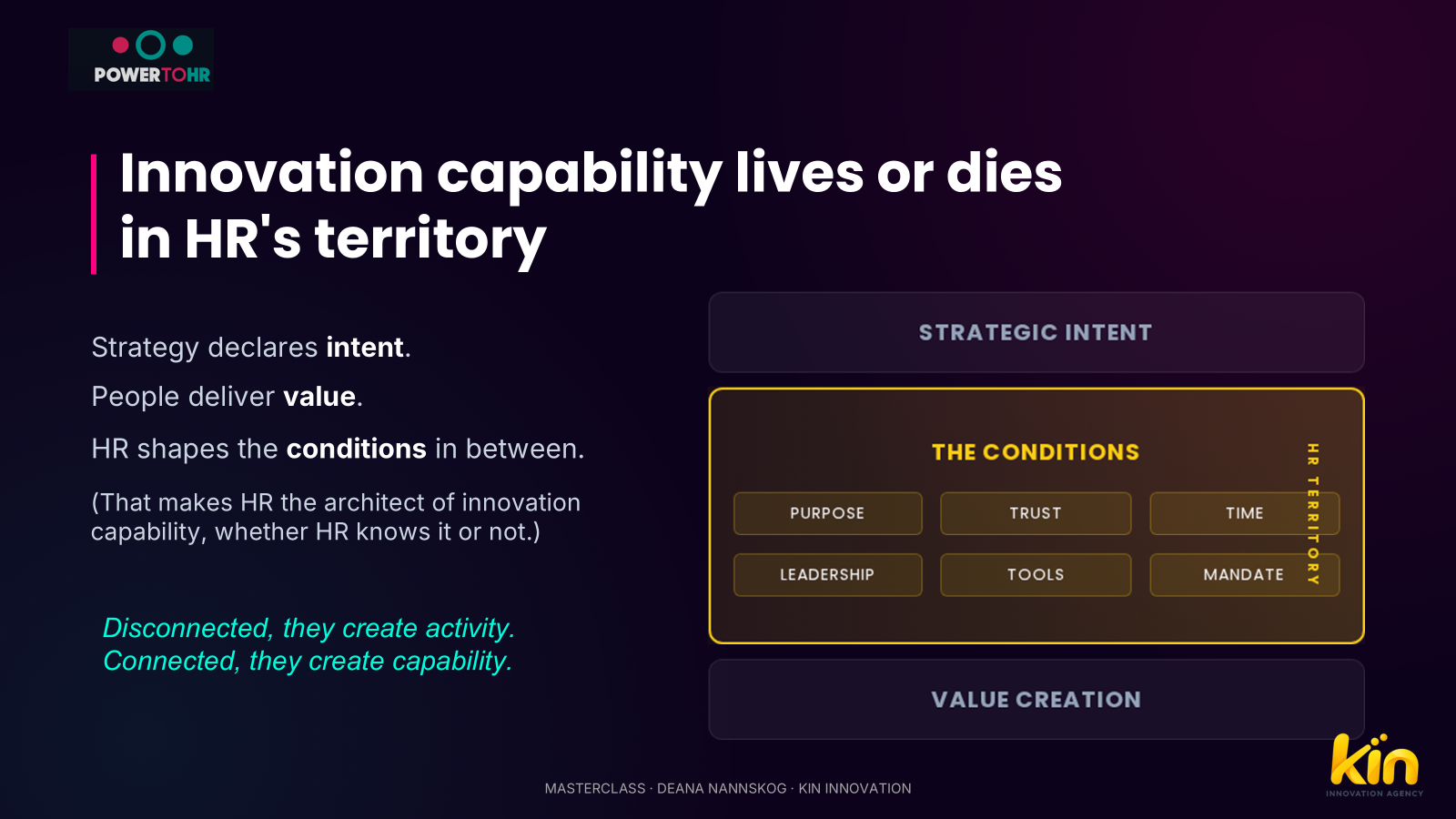
Those conditions are not neutral infrastructure. They are HR territory, the domain where HR makes decisions every day, through culture programmes, leadership frameworks, governance structures, performance systems, and how people's time is protected or consumed.
HR's invisible hand in innovation
Most HR functions do not experience themselves as innovation architects. They experience themselves as people functions: attracting talent, developing capability, supporting managers, managing compliance. The connection to innovation capability is rarely explicit.
But it is always real. Because the conditions that make innovation possible, or impossible, are the same conditions HR shapes: psychological safety, time for exploration, clarity of purpose, leadership that models learning, tools that enable collaboration, mandate to make decisions at the right level. When HR decisions build these conditions, innovation happens. When they undermine them, innovation stalls. Not because people lack ideas or ambition, but because the system does not allow those things to become capability.
"Disconnected, they create activity. Connected, they create capability."
Why the conditions fail separately
This is the central challenge. The six conditions are rarely entirely absent. Most organisations have purpose statements, leadership programmes, digital tools, some degree of mandate. But they are often disconnected, each designed in its own silo, each optimised for a different audience, each measured in different ways.
- Purpose without trust means people know the direction but are not safe enough to move toward it.
- Trust without time means people feel supported but are too consumed by operational demands to act.
- Tools without mandate means people have the means but not the authority to use them well.
- Leadership without clarity means people have role models but no shared understanding of what they are modelling toward.
When the conditions are connected, when purpose, trust, time, leadership, tools and mandate are designed as a system oriented toward the same value, they create capability. That shift, from disconnected conditions to a connected system, is exactly what HR is positioned to lead.
The architecture question
Most organisations ask HR to deliver programmes. The more strategic question is whether HR is designing conditions. The difference is significant. Programmes are events. Conditions are infrastructure. Programmes can be measured by attendance. Conditions are measured by whether the organisation becomes more capable of creating value.
HR sits between strategic intent and value creation. It always has. The question is whether HR uses that position deliberately, to design the conditions that connect intent to capability, and capability to value.
Innovation capability lives or dies in HR's territory. The question is whether HR knows it, and whether it is using that territory deliberately.
References
- Amabile, T. M. (1996). Creativity in context: Update to the social psychology of creativity. Westview Press.
- Edmondson, A. C. (2018). The fearless organization: Creating psychological safety in the workplace for learning, innovation, and growth. Wiley.
- Ulrich, D., & Brockbank, W. (2005). The HR value proposition. Harvard Business School Press.
- West, M. A., & Farr, J. L. (Eds.). (1990). Innovation and creativity at work: Psychological and organizational strategies. Wiley.