From three logics to one shared value system
By Deana Nannskog
Most organisations run on three separate logics: HR optimises for employees, business for customers, technology for digital systems. Each is internally coherent. Each is largely disconnected from the others. That disconnection is the fragmentation problem, and it cannot be solved with better coordination alone.
Most organisations run on three separate logics. HR is optimising for employee experience: skills, learning, culture, leadership. Business is optimising for customer and market outcomes: direction, priorities, performance. Technology is optimising for digital systems: data, infrastructure, AI.
Each logic is internally coherent. Each has its own language, its own metrics, its own leadership priorities. And each is mostly disconnected from the others.
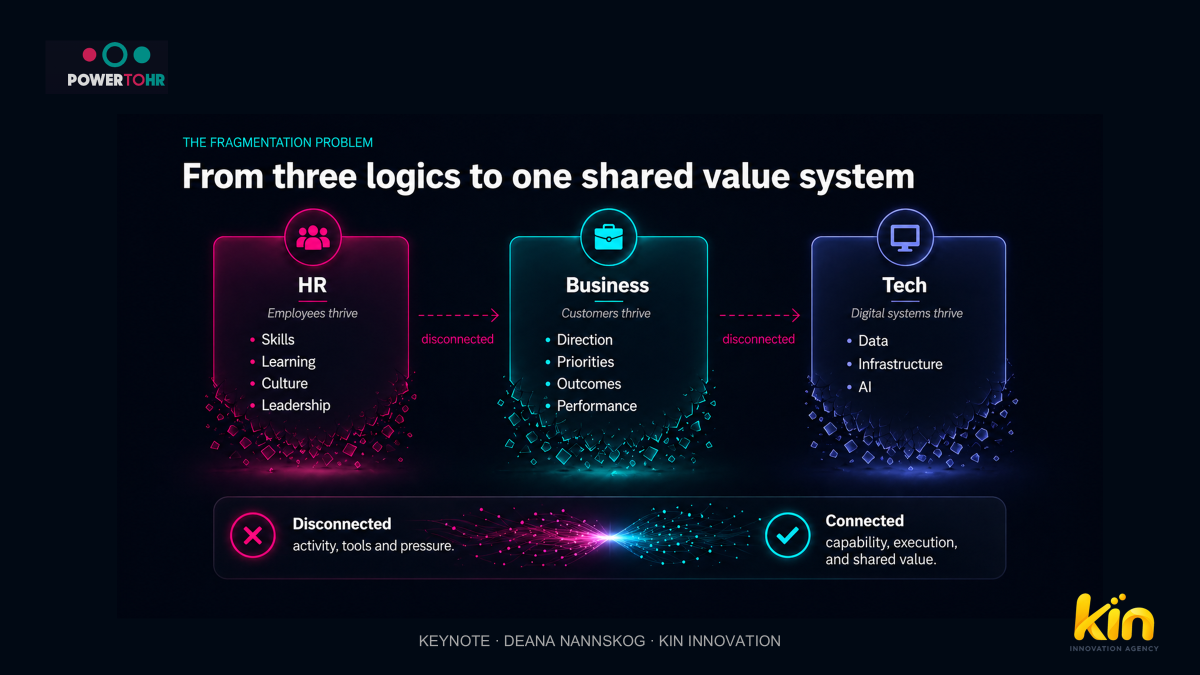
Three logics, one fragmentation problem
The fragmentation is not an accident. It is a natural consequence of how organisations have divided responsibility over decades. HR owns people. Business owns strategy. Technology owns systems. Each function has become increasingly sophisticated within its own domain.
The problem is that value is not created within any of those domains. It is created at the intersection of all three. The moment a strategy requires people to act, using systems, in service of outcomes, which is most of the time, the three logics need to work together. And they often cannot.
The symptom is recognisable: a strategy that leaders believe in but the organisation cannot execute. An AI rollout that technology delivers but people do not use. A skills initiative that HR builds but the business does not connect to any real decision. Activity, tools and pressure, but not capability, execution and shared value.
"Disconnected: activity, tools and pressure. Connected: capability, execution, and shared value."
Why coordination is not enough
When the three logics operate independently, each produces its version of effort. HR runs programmes. Business runs initiatives. Technology implements systems. But because the logics are not connected, the effort does not compound. Each function can honestly say it is doing its job, and the organisation still cannot do what the strategy requires.
The usual response is more coordination: more cross-functional meetings, more steering committees, more alignment workshops. These help at the margin, but they do not solve the underlying problem. Coordination assumes a shared frame. The fragmentation problem is that the three logics do not share one.
One shared value system
The shift from three logics to one shared value system is a design challenge, not an alignment exercise. What it requires is a shared language for value: one vocabulary across HR, business and technology that describes what the organisation must be able to do, and why it matters.
When HR, business and technology leaders can agree on what organisational capability must deliver, and translate that into their respective domains, the three logics start pulling in the same direction.
- HR's contribution becomes defined by capability outcomes, not programme outputs. Not 'we ran a leadership programme' but 'leadership decisions are faster and better-informed at this level of the organisation.'
- Business's contribution becomes capability-aware, not just performance-focused. Not just 'we hit the target' but 'we built the ability to do this reliably, and we know when it is not working.'
- Technology's contribution becomes part of the capability system, not a separate track. Not 'we implemented the AI tool' but 'the tool is embedded in how people work and the organisation is becoming more capable because of it.'
The goal is not to make HR, business and technology agree. It is to give them something to agree about: a shared understanding of what value the organisation must create, and what it must become able to do to create it.
References
- Galbraith, J. R. (2002). Designing organizations: An executive guide to strategy, structure, and process. Jossey-Bass.
- Kaplan, R. S., & Norton, D. P. (1996). The balanced scorecard: Translating strategy into action. Harvard Business School Press.
- Porter, M. E., & Kramer, M. R. (2011). Creating shared value: How to reinvent capitalism and unleash a wave of innovation and growth. Harvard Business Review, 89(1/2), 62–77.
- Ulrich, D., & Brockbank, W. (2005). The HR value proposition. Harvard Business School Press.