The world changed. Our organisations did not.
By Deana Nannskog
Organisations were designed for a world of stable conditions, clear roles, predictable skills and slow change. That world is gone. What replaced it cannot be managed. It has to be designed for.
There is a slide in my keynote that tends to land hard. Two columns. Before and After. Stable versus constant disruption. Clear roles versus blurry roles. Predictable skills versus skills that expire fast. Slow change versus continuous change. And now: AI in the workflow.
It is not a complicated slide. But something about seeing it laid out plainly, the contrast between the world organisations were designed for and the world they now operate in, tends to create a moment of recognition.
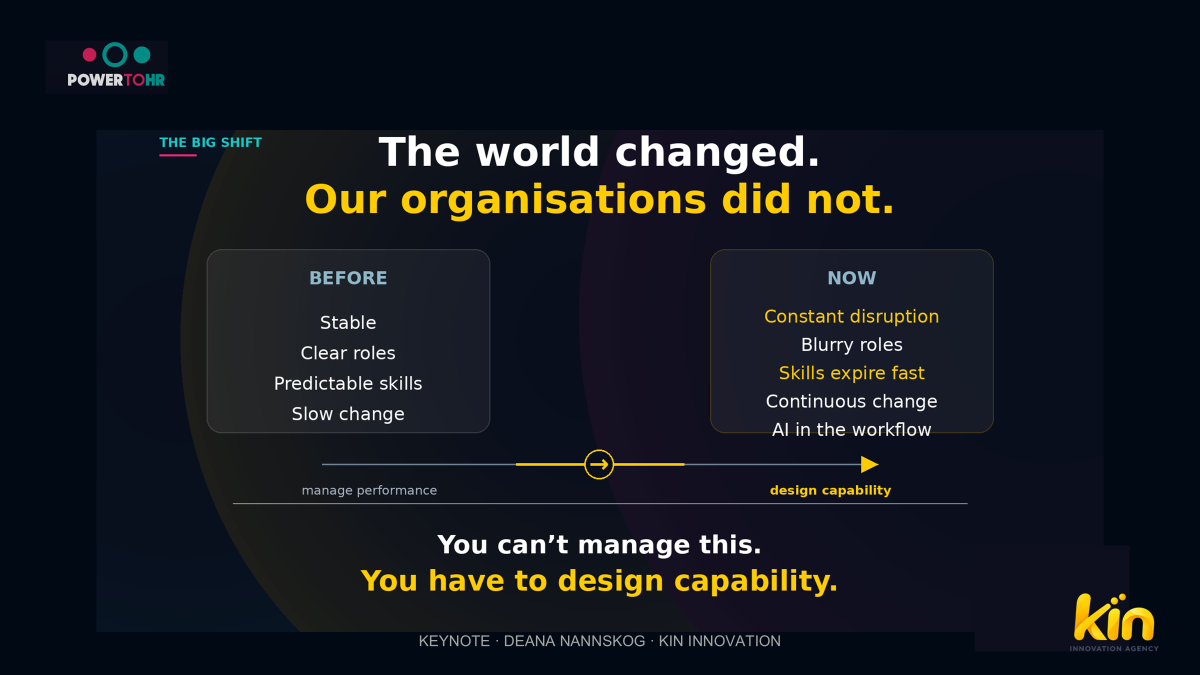
We are managing for a world that no longer exists
Management as a discipline was built for conditions of relative stability. When roles were clear, you could define performance against them. When skills were predictable, you could train for them. When change was slow, strategic planning had a reasonable shelf life.
Those conditions are gone. In their place: constant disruption, blurry roles, skills that expire faster than training programmes can respond to, and AI embedding itself into workflows before most leaders have understood what it is doing there.
The tools organisations still reach for, performance reviews, competency frameworks, annual learning cycles, were designed for the 'before' column. They are increasingly inadequate for the 'now'. Not because the people using them are wrong, but because the assumptions underneath them no longer hold.
You can't manage this. You have to design capability.
The shift from managing performance to designing capability is not a semantic distinction. It is a fundamental change in what leaders need to do.
Managing performance assumes a relatively stable environment: you set targets, measure against them, reward or correct. It works when you know what performance should look like. Capability design assumes a changing environment: you create the conditions for people to learn, adapt and do what the organisation needs, including things you cannot yet fully specify.
"You can't manage this. You have to design capability."
What capability design actually requires
- Direction that is clear enough to act on but loose enough to allow adaptation. Not a fixed plan, but a shared understanding of what value must be created and why it matters, so people can exercise judgement when the situation changes.
- Conditions that allow people to act: governance, time, psychological safety and permission to test, learn and sometimes fail without career consequences. Without these conditions, capability that exists in individuals never becomes organisational capacity.
- Learning loops that turn experience into repeatable ability. Not training programmes that happen once. Mechanisms that make learning a continuous feature of how work happens, rather than an occasional scheduled event.
- Feedback that shows whether capability is growing, not just whether targets are being hit. Most performance systems measure inputs and outputs. Few measure the ability of the organisation to adapt and respond, which is precisely what a changing world demands.
The diagnostic question
The shift most organisations need to make becomes visible when you ask one honest question: are we designing for the world we have, or managing for the world we used to have?
Most are doing both, which means neither is done well. The performance systems optimise for stability while the world demands adaptation. The capability initiatives get crowded out by the urgency of short-term performance. The gap between what the organisation needs to become and what the management system rewards keeps widening.
Performance management assumes a stable world. Capability design assumes a changing one. Only one of those assumptions is still accurate.
References
- Christensen, C. M., & Raynor, M. E. (2003). The innovator's solution: Creating and sustaining successful growth. Harvard Business School Press.
- Drucker, P. F. (1999). Management challenges for the 21st century. Harper Business.
- Hamel, G., & Prahalad, C. K. (1994). Competing for the future. Harvard Business School Press.
- Teece, D. J. (2007). Explicating dynamic capabilities: The nature and microfoundations of (sustainable) enterprise performance. Strategic Management Journal, 28(13), 1319–1350. https://doi.org/10.1002/smj.640
- Toffler, A. (1970). Future shock. Random House.